
The orphanhood of Martin Sullivan is not well documented, if at all. Perhaps he was taken in by Clasykinleen kin, or maybe he found a home back towards Glanmire and Sullivan’s Quay. Perhaps, in the decades before Poor Law provision and the Fermoy workhouse, he forged his own path on the garrison streets. Perhaps he found some middle ground. If he did, he didn’t stray far. The next time Martin surfaces in the record is twelve miles away in the neighbouring Mitchelstown, standing before a priest with witnesses in St Fanahan’s church, Brigown, on Tuesday, 19 November 1844. His bride is Mary Keleher – a name which leans more toward west Cork and Kilmichael than north county. Their many witnesses – Pat Keleher, Margaret Regan, William Coter, Mary and John Glavin, Mary Murphy – are noteworthy for the absence of any obvious Sullivan or Riordan kin, suggesting Martin’s childhood refuge may have followed the second ‘perhaps’.
The record falls silent once more until the baptism of Martin and Mary’s third child, Thomas, in Westmeath, on 22 July 1848. In the grip of food insecurity, and with a young family to provide for, Martin and Mary would have been driven to move in search of survival. His skill set was an inheritance from his father and, as unskilled labour, he followed the work.
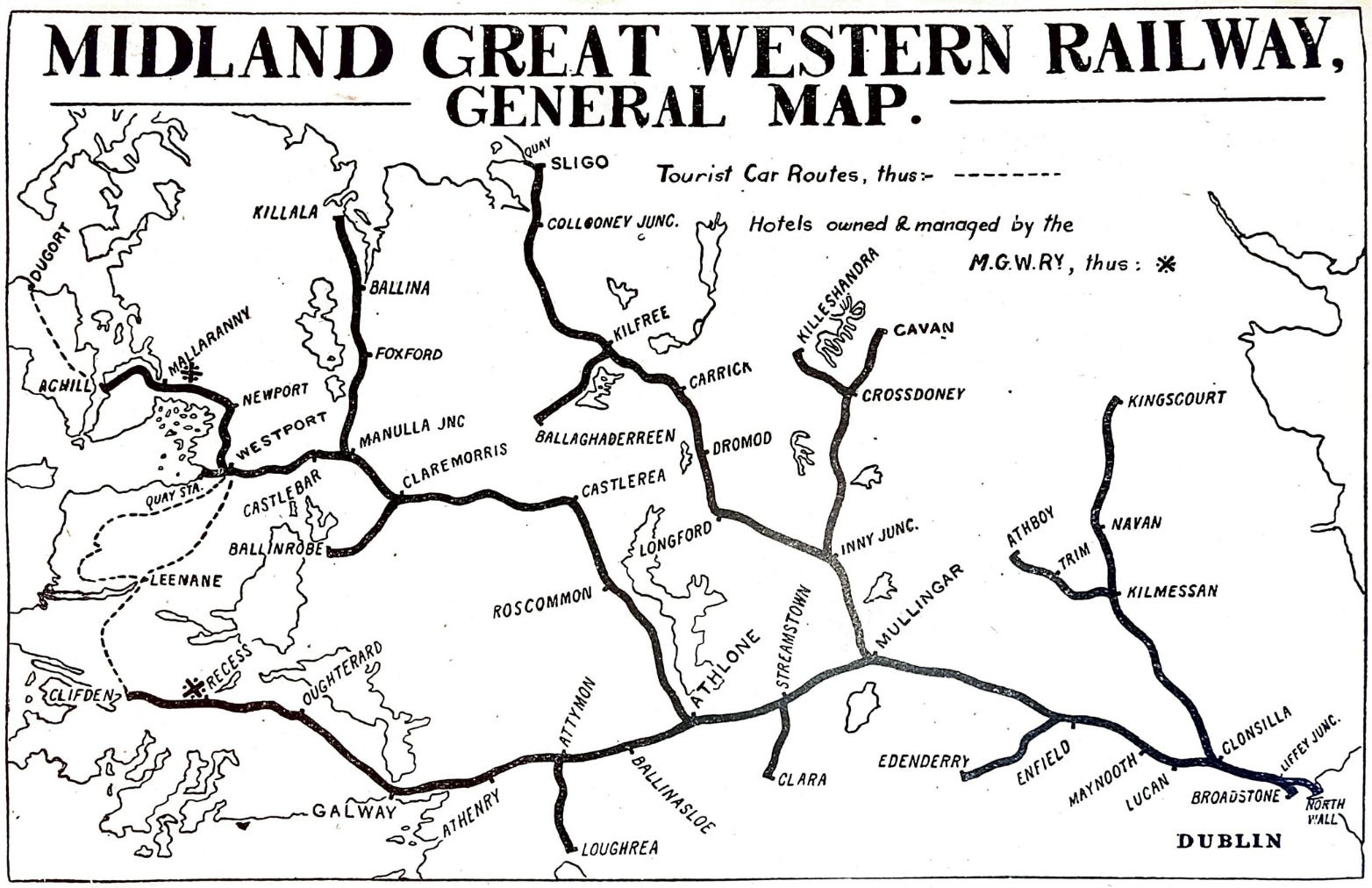
That they were in Mullingar was not coincidental. In 1845, the Midland Great Western Railway of Ireland Act facilitated the construction of a line running west from Dublin; further enactments later extended the works to Athlone and Galway. Construction started at the Broadstone terminus in January 1846, and by August of that year crews were already at work near Mullingar, laying foundations alongside the Royal Canal at Saunders Bridge. By early 1848, 1,768 casual and semi-skilled labourers – like Martin – had been drawn into the immediate vicinity of the town. The sheer scale of the undertaking explains his presence. Martin was displaced, without traditional ties to a homeplace, evidently mobile with his young family. The project presented an opportunity for itinerant contractual engagement, through contractors and subcontractors, with navvies paid for the volume of earth moved or the weight of masonry laid rather than by any fixed daily wage; an arrangement that would have promoted mobility rather than security beyond the completion of the given task. The line reached Mullingar in September, with the first train from Dublin Broadstone on Monday 2 October 1848, hailed as “a great project — one calculated to extend civilisation, promote trade and agriculture, and increase the wealth and comfort of the people.” The “commodious but temporary structures” at Mullingar were eventually replaced in 1856 on the completion of architect George Wilkinson’s station. This detail reflects something of what Martin would have noted on his own arrival — a town under construction, with its station, yards, and approach roads yet to emerge from the blueprint. He was likely absorbed into the eventual completion of the embankment, the fitting out of sidings, or the ancillary works associated with the temporary station, placing Martin as another otherwise anonymous navvy within a workforce whose collective effort was judged sufficient to transform the “wealth and comfort” of the country it traversed.
Such a role was not worthy of a name-check on the record. The MGWR did not think to gift future generations with the pleasure that might be derived from muster roll-style detail. Rather, the company’s surviving documents weigh heavily toward the engineering and financial administration rather than the day-to-day mundanity of the individual lives of those navvies who made it happen. The macro-significance of the MGWR went far beyond them, placing Mullingar, and the midlands, at the heart of a system which, within the following decade, would connect to Athlone, Galway, Longford, and Sligo, then Cavan and the Ulster network.