
Jeremiah Sullivan was born in 1785 near Sullivan’s Quay in the South Parish of Cork, within the civil parish of St Nicholas. An origin story with an eponymous locus sounds awfully grand, but before him, the line is lost to the crowd.
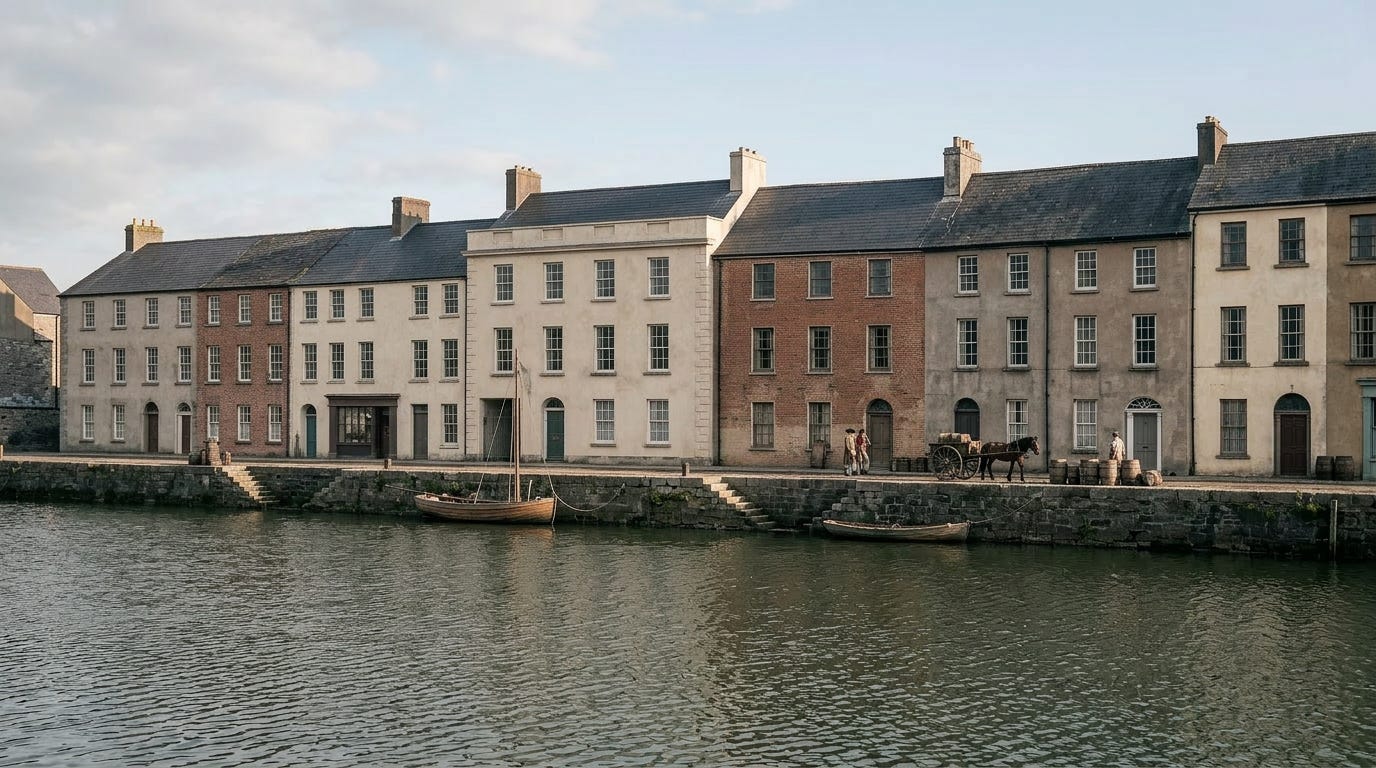
What can be said is that, in 1726, an area abutting the south channel of the River Lee is recorded on John Carty’s survey of the city as “Boch’s Key”. By 1750, Charles Smith’s plan of Cork has the same frontage as Sullavans Key, with John Rocque’s 1759 survey confirming the designation of Sullivan’s Quay, a frontage of merchant warehouses, docks and provisioning yards. The rationale for the change is not documented. It seems likely that the designation was for a family line embedded in the commercial life of the South Channel over the intervening generation rather than any particular personality.
The self-styled head of the O’Sullivan Mór sept, Benjamin Sullivan (1720–1767), attorney‑at‑law, was appointed clerk of the crown for the counties of Cork and Waterford in 1753. He was a son of Philip O’Sullivan (1682–1737), a Catholic by birth, and Elizabeth Erwin, a Presbyterian from Co. Roscommon. Philip had settled in Cork city in the early eighteenth century, with lineage associated with Dunkerron Castle on Kenmare Bay rather than Dunboy on the Beara peninsula, the principal seat of the O’Sullivan Beare.
By Philip’s time, the title had long been severed from the territory, leaving a lineage without estate. When he was buried from St Mary’s, Shandon, it was operating as a Church of Ireland parish church in a city governed by the Penal Laws. Philip’s trajectory was not inconsistent with legislative restrictions on Catholic access to property, inheritance and the courts, which encouraged tactical alignment with the established church. Benjamin managed, rather than resolved, this tension through outward conformity. Abbreviating the family name and taking public office consolidated his inheritance from Philip into professional standing. By Jeremiah’s time, Benjamin’s sons had extended that reach far beyond Cork: one on the bench in Madras, another as an under-secretary for War and Colonies, a third raised to a baronetcy.
Surveying Cork in 1790, French consul Charles Étienne Coquebert de Montbret encountered near the Parade an O’Sullivan keeping a beer‑house and displaying the family arms in his porter‑room; he further speculated, not entirely in earnest, that the establishment was “perhaps …a house of ill-fame”. Another Jeremiah Sullivan was a printer, bookseller, stationer, subscription agent, paper merchant and lottery‑office keeper at 53 Castle Street, opposite the Exchange and under Leary’s Coffee House.
David Dickson’s account of Cork and South Munster in these years depicts a mercantile city with prosperity reliant on imperial provisioning and Atlantic trade, an environment in which a family with ambition could reposition itself beyond confessional and socioeconomic boundaries. The lawyer, the publican and the bookseller: three branches of one Brehon fine together in the same city, each taking his own line.
Whichever the line, it was unlikely to have been written for our Jeremiah. As a nineteen-year-old labourer standing five feet four and a half, of dark complexion, with grey eyes and dark hair, he stepped out of the crowd at Gosport on 4 April 1805 to take the King’s shilling and attest for life into the 2nd Battalion of the 58th (Rutlandshire) Regiment of Foot.
Very good