
By the time the battalion settled into its Jersey routine, the War Office returns had fixed Jeremiah Sullivan within a continuous administrative course of conduct that leaves only narrow, unrecorded margins for any return to Cork. It is within one such margin that a Catholic marriage register appears to record the union of Jeremiah Sullivan and Johanna in the South Parish on 14 January 1807, with the bride’s partially legible surname most plausibly read as Riordan.
Their son, Martin, was baptised in St Michael’s Catholic church, Glanmire, on 18 November 1808, with Timothy Donohue and Juliana Scully as sponsors. On the public register, the priest first wrote Juliana’s surname as Sullivan before correcting it to Scully—a clerical error to show even contemporaneous records should be read with forensic caution.
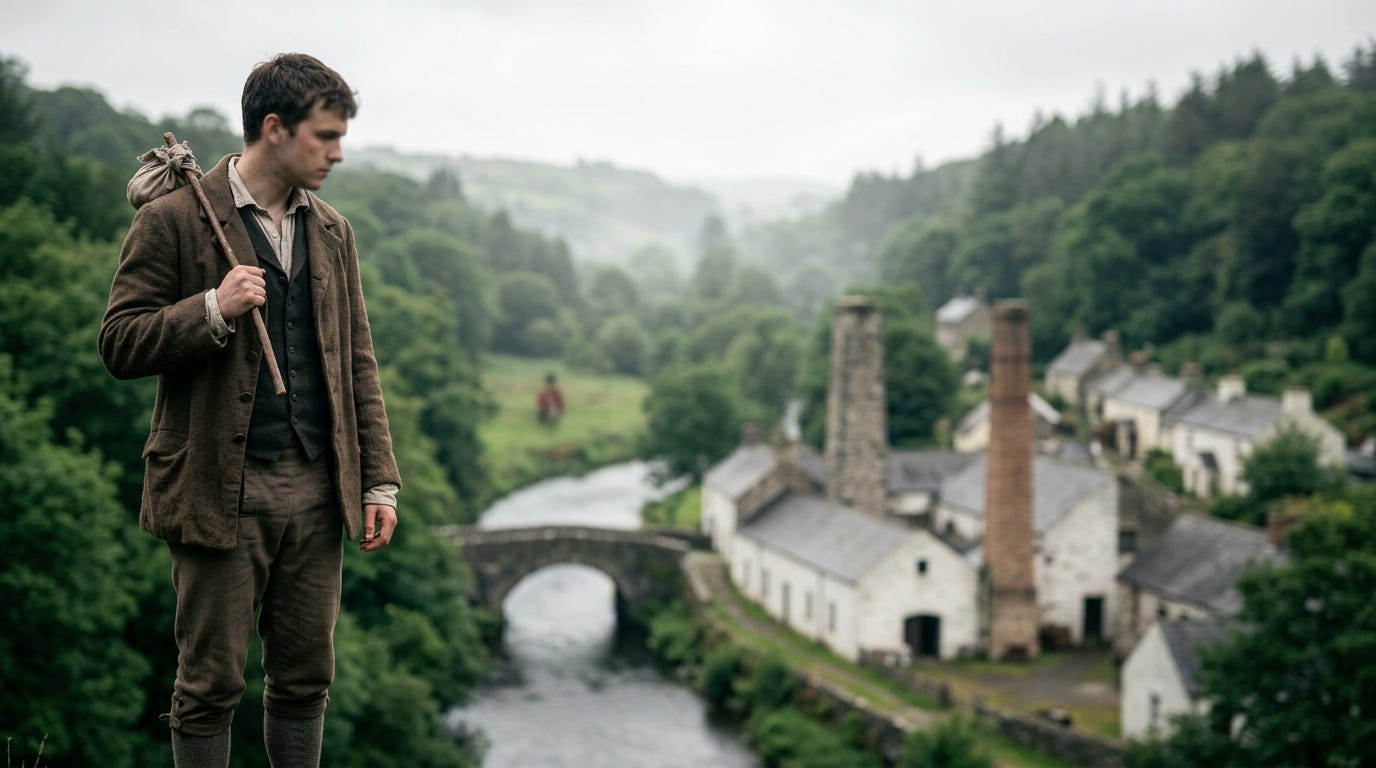
Glanmire, on the Glashaboy River a few miles north‑east of Cork city, was by the early nineteenth century a small industrial settlement of mills and workers’ houses — a middle ground between town and country, close enough to the docks, yards and quays for a labouring household to live within the economic pull of the city, yet still rooted within a parish landscape exposed to the fluctuations in grain and shipping prices that left wages unpredictable and subsistence precarious.
On Johana’s side, a working hypothesis connects her to Clashykinleen West, a townland in the civil parish of Kilmeen in the north‑west of the county. At the turn of the nineteenth century, land in rural Cork was divided, rents were rising, and the balance of the county’s economy was already tilting toward the port city, whose growth rested on export trade, provisioning and the associated demand for transport, milling and casual labour. For smallholders and labourers on marginal ground, there was limited scope to absorb demographic pressure without either subdivision or outward movement; one recognised response, well before the later nineteenth‑century crisis, was to seek wage work in or near Cork, while leaving kin ties and residual claims in the countryside intact. A movement of that nature would fit the wider pattern described for Cork’s working population, in which families from the rural interior gravitated toward urban and quasi‑urban settlements proximate to the city and to a sense of security in subsistence, whilst retaining the solidarities of a recognisable parish community.
The muster rolls neither confirm nor exclude the possibility that Jeremiah was physically present at the font on that November day; what they do show is that, while a child of his name and blood was being entered in the Glanmire register, he remained on the strength of the 2/58th. Martin’s baptism and his parents’ marriage sit at the point where those trajectories intersect, with the fields of Clashykinleen West meeting the streets of the South Parish. For the War Office, Jeremiah in these years remained a number in the 2/58th; for the parishes, he is recorded as both a husband and a father, briefly moving from the abstraction of a private soldier into the more durable record of kinship and faith.