
So, what became of our Jeremiah? The muster logs that tracked him on Jersey to June 1809 then present a lacuna, followed by three distinct, plausible paths from Lisbon.
The first is that of Jeremiah Sullivan (1/58th), recorded on the 1st Battalion’s winter pay‑list of 1814–15 as a labourer of St Nicholas, Cork, and reappearing the following winter as a private in Company 8, three months after the 2/58th was disbanded at Hull. His civil parish, his pre-enlistment occupation, and his timings are all consistent with what is known of our Jeremiah. A transfer to the 1/58th is consistent with a soldier “for life” still fit for service. His return path takes him towards Cork, and then, most plausibly, to the garrison town of Fermoy. This Jeremiah sounds like our Jeremiah.
The second is Jeremiah Sullivan (57th), who was discharged from the 2nd Garrison Battalion on 23 October 1816, aged thirty-one. He was described as standing five feet four and three‑quarter inches, with dark brown hair, grey eyes and a dark complexion — a description strikingly similar to that of our Jeremiah from 1805. That said, although his town is noted as Cork, the parish is recorded as St Munchin’s and his county as Limerick. Like the clerical error in Glanmire, placing Cork in Limerick prompts a forensic caution. The accompanying statement of service notes two years and 208 days in the 57th Regiment of Foot, followed by five years and 17 days in the 2nd Garrison Battalion — giving a total service of seven years and 297 days. Although the musters for the 57th and 58th reflect different paths, this Jeremiah does look remarkably like our Jeremiah.
The third is Jeremiah Sullivan (2/58th), a private soldier in Company 8. He spent eighty‑one days in hospital during the quarter to December 1809, immediately after the lacuna. In the following quarter, he was still in hospital until 1 February 1810, when the muster simply notes “Died 1st Feby”. That is all. There is no cross‑reference to a pension certificate and no indication of a cause of death. In the context of a battalion that had recently landed in Lisbon, there was a marked increase in hospital cases across the 2/58th; fever and perhaps dysentery were likely relevant factors.
John Pead, Honorary Historian of the British Cemetery in Lisbon, has confirmed a gap in the cemetery’s burial registers between 1807 and 1811, and found no inscription and no separate army death record for Jeremiah Sullivan, and concludes that, if he lies in that ground, the paper that would tell us where has not survived. This Jeremiah has the shortest path to our Jeremiah.
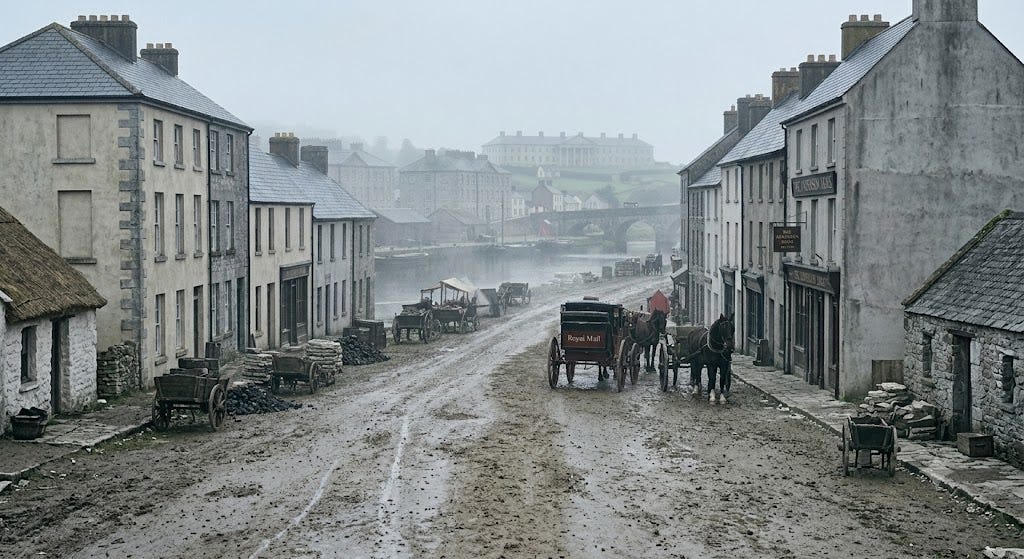
The winter of 1815–16 was particularly tough. The eruption of Mount Tambora in April 1815 caused severe climate abnormalities throughout the Northern Hemisphere. As a result, 1816 was known as ‘the Year Without a Summer’, with 142 days of rain in Ireland devastating harvests coinciding with the economic depression that followed the Napoleonic Wars. The provisioning trade that had sustained Cork contracted sharply, exposing vulnerable households to economic pressures they could neither predict nor control. Famine was prevalent and, from 1817, accompanied by a typhus epidemic.
In Dublin, admissions to Cork Street Fever Hospital soared, from 2,752 in 1817 to 3,720 in 1818. The hospital physicians estimated that in an eighteen-month period, 1.5 million people had suffered from fever. Over 40,000 deaths occurred in Ireland due to famine and disease in 1816–1817, with potentially more going unrecorded.
1817 did for Johana. Aged thirty‑one, having sought the security of a garrison town, she met instead with famine and fever in Fermoy. Martin survived. An orphan, aged just eight.