
By 1850, the family—Eliza (1846–71), John (1847–67), Thomas (1848–1925) and James (1849–83)—was in Belfast, where Maurice (1850–1916) was born. What came between is, by necessity, a matter of faction: a best guess bounded by Thomas and Maurice, grounded in geography, transport and the pressures that shaped contemporary population shifts.
While construction on the MGWR continued westward, Martin looked to the east, and beyond, along northern lines. There was a perception, albeit misplaced, that Belfast — Linenopolis — was in some way exempt from the Great Hunger. The inscriptions in Friar’s Bush tell a different story: the graveyard’s ‘Plaguey Hill’ increased by around eight hundred burials during the period, many of them migrants from Connacht who sought refuge in the town only to succumb to fever or exhaustion. Belfast grew, but it grew by absorbing the displaced; its apparent immunity was an illusion created by industry, not by circumstance. Yet perception mattered. From a distance, the chimneys signalled work, and work meant survival. For Martin and Mary, whose young family had few secure ties, the draw of Linenopolis lay in its promise of continuity.
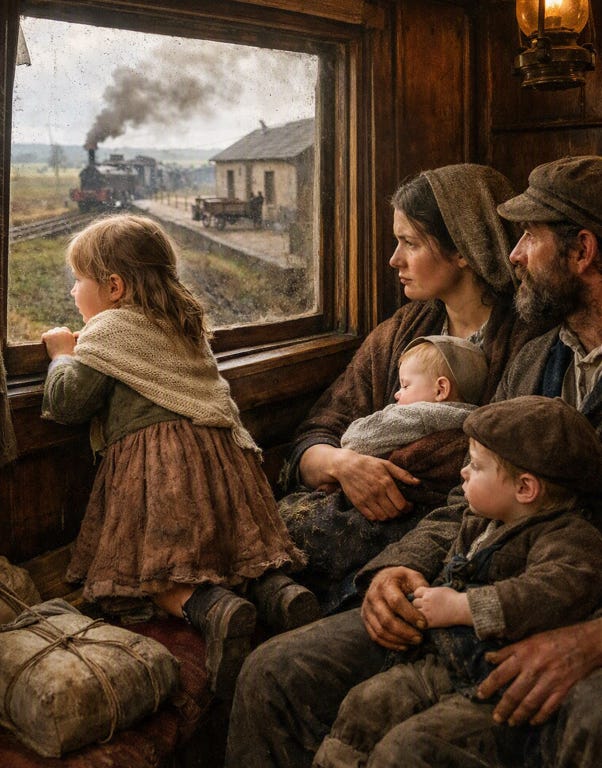
They left Mullingar in the early light. Eliza was old enough to notice what passed beyond the carriage window, and young enough to believe that every stop might mark their journey’s end. John, the toddler, shifted on Martin’s lap; Thomas lay against Mary’s breast. The train exhaled, impatient, as though urging them to decide whether they were truly leaving or merely lingering. Pulling away with a shudder, the railway found the Royal Canal as it began to leave the town behind. The familiar soon gave way to the rural: fields marked by the recent blight, uneven soil broken in search of whatever remained. Mary bore silent witness, heavy, while Martin rested his hand upon the coarse bundle beside him, loosely fastened with string – the sum of all that could be carried.
The canal kept them company; a turf boat bobbing past a lock-keeper’s cottage, its whitewash flaking to reveal the naked grey beneath. Eliza asked where it was going. Martin told her it was bound for Dublin, like them. The answer was enough for her; the man standing in the doorway, the cold chimney, and the stillness of the place did not seem worthy of question. Soon the train slackened at Killucan: a low platform, a modest station building, and a waiting cart. Eliza rose to peer out and asked whether they were there yet – her first guess at measuring distance. Martin replied with a smirk. “Not quite.” Before she could settle, the carriage jolted, and her view returned to fields and farms. He turned back to the gossins. To Eliza, their journey seemed without end. To Martin, they were putting distance between one life and a new beginning. She counted each station with diminishing expectation that it might be their destination, losing interest well before Maynooth. Martin pointed to a grey hulk in the distance and told her, with a modicum of pride, that it was the world’s greatest seminary—a thing he had once been told and saw no reason to question. Eliza stared through the window with disinterest enough not to ask. Pressing eastward, their view began to thicken with roads, houses, and intermittent industry before Dublin engulfed them. Slowing through sidings, warehouses, and close-built streets, the train drew into the Broadstone terminus.
The family gathered, the children clinging to their parents as they stepped awkwardly into the cobbled streets. Martin knew a man who had once told him the way. Through the King’s Inns and onto Henrietta Street, where the ordered façades lent a grandeur, they descended through the throngs of Capel Street: the clatter of carts, the calls of hawkers, the smells of horses and spilt grain contesting with people.
“You’ll see the dome of the Four Courts down by the river, to your right,” the man said. “If you’re on the Quay, you’ve gone too far. You want to be going left before then: Abbey Street, past the Hospital, and towards the next great dome—that’s the Custom House.” Turning towards Amiens Street and their next station, Eliza might reasonably have thought they had arrived. Her curiosity had given way to hunger. Mary hoked for the bread tucked into their bundle as the sights and sounds of the morning platform were replicated, though amplified a hundredfold. They clambered aboard once more. Her forever was not so long: Eliza cuddled into Mary and let the rhythm of the tracks nurse her to sleep.
It was close to midday as they alighted at Drogheda, crossing the Boyne on foot to Newfoundwell. Peering out from their next train, Eliza saw much the same as in the morning, yet somehow different. Martin marvelled at the great new infrastructure, taking some pride in his part in its making. At Dundalk Junction, another change: Barrack Street and the start of a new Enniskillen line towards Castleblayney. The novelty wore off as the track ran out, and they continued by road, on foot, towards Armagh. A passing cart took pity as they climbed to Keady and then on to the city. As the light began to fail, Mary determined that they had come far enough for one day. Martin went in search of a bed for the night.
The next morning, they were awakened by a whistle as the first Belfast train left without them, leaving them to explore. Eliza did not see a city like Dublin: Armagh was more like home—like Mullingar—but with a great church Martin told her was called a cathedral, looking down upon her—its stone catching the morning light—and another rising on the hill opposite.
Rested, midmorning, the Ulster Railway carried them on to Portadown. As the train slowed, the next place Eliza noticed was Lisburn. The air changed – sharper, busier, carrying the faint whiff of industry, drawing them ever closer. Mill chimneys and bleach greens, and wagons working the roads. Belfast announced itself before the train had even stopped. Chimneys multiplied; factory whistles carried through the smoke; narrow rows of red-brick houses pressed close to the line; the rails divided and converged amid coal wagons, signal posts, engine sheds and the shouted instructions of railway workers. At Great Victoria Street, the family emerged to be absorbed into the bustling town, the smell of coal smoke hanging in the cold, dank air.
One journey had ended; another, about to begin.