
Food insecurity was a recurring theme in nineteenth-century Ireland. Seasonal employment, limited access to credit, overreliance on a single crop, and the discretion of landlords and their agents left vulnerable households exposed to fluctuations in harvests, prices, and work. Government interventions varied in form and scale but proved consistently inadequate to the needs created by recurrent subsistence crises.
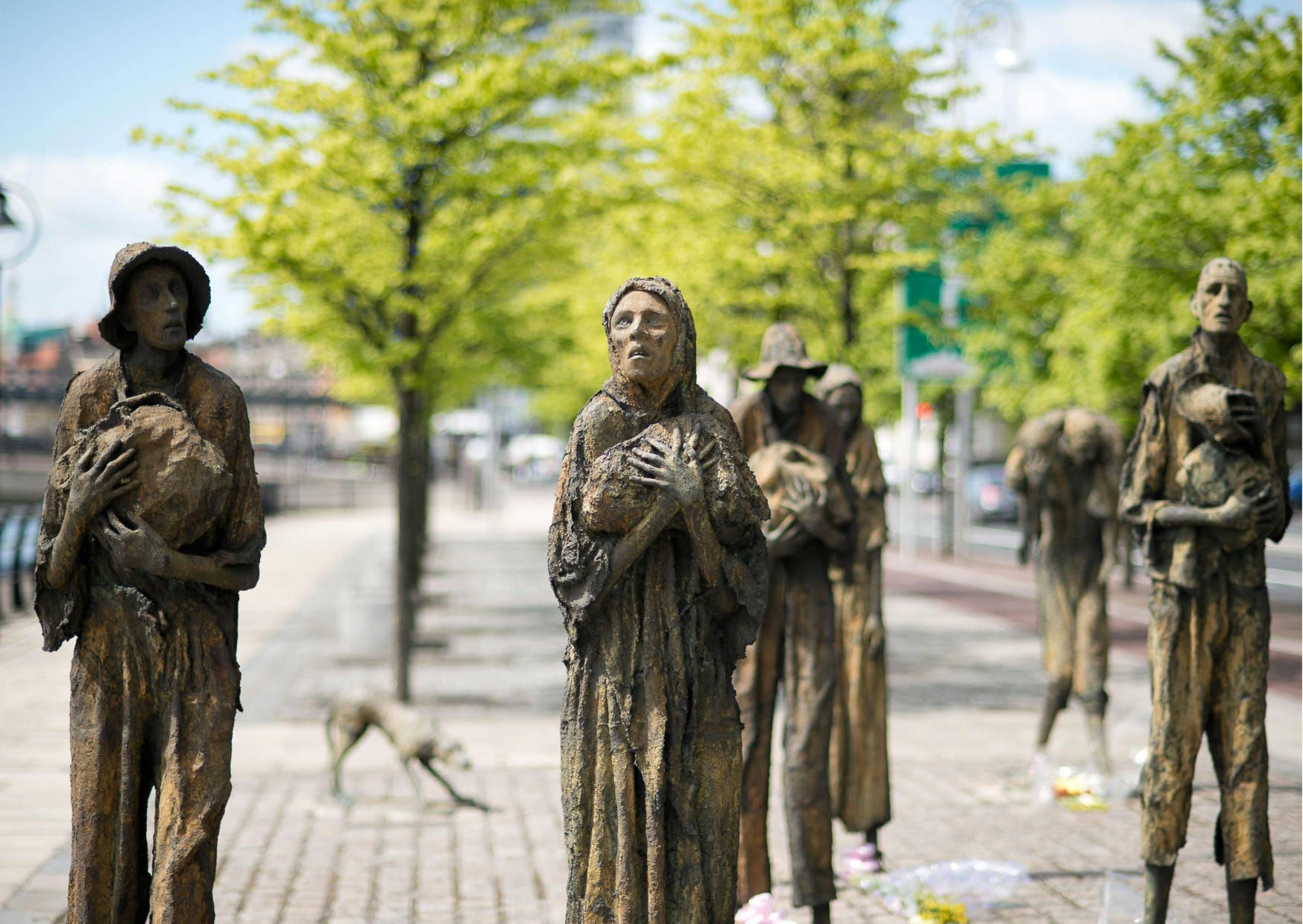
Such recurrences pre-dated the Act of Union and post-dated partition. In 1740–41, mortality levels relative to population were comparable to those of the 1840s. Although the harvest crisis of 1799–1801 brought exceptional dearth – the price of oatmeal and potatoes rising fourfold – widespread mortality was averted. The subsistence crisis of 1816–19 left Martin Sullivan an orphan. This was followed by severe regional distress in the south and west in 1821–22, and again in the early 1830s. When the potato crop failed in 1845, it might reasonably have been understood as another recurrence within an established pattern. No one could have anticipated that the blight would recur the following season, nor in the next, and then again.
There was severe distress in 1879–80 once more due to crop failure, particularly in the west. Railways, charitable subscriptions and a more organised relief effort made assistance more readily available. It also highlighted the continued dependence of subsistence farming communities on their potato harvest, feeding into what became the Land War.
The War of Independence (1919–21), the Civil War (1922–23), and their aftermath severely disrupted supplies, infrastructure, transport, and employment. For rural communities on both sides of the border, poverty persisted throughout the 1920s and 1930s.
Food insecurity within the United Kingdom of Great Britain and Ireland – a state with exceptional industrial, commercial, fiscal, and maritime resources – was paradoxical. How that state understood, restricted, deployed and administered those resources within its own territories during 1845–52 requires closer scrutiny.
In 1845, Phytophthora infestans destroyed the single crop upon which a large proportion of Ireland had come to depend: the potato. It did not, however, occasion a general failure of food production. James Fintan Lalor (1807–1849) made the distinction in contemporary terms: famine, properly so called, meant a general scarcity of food; Ireland, he maintained, had suffered scarcity only in “one solitary species of vegetable”. The country’s soil continued to produce grain, livestock, vegetables and other provisions, subject to ownership, sale and export.
Despite a markedly different outlook and conclusion, C. E. Trevelyan (1807–1886) materially supports Lalor’s factual premise, albeit inadvertently. As Assistant Secretary to the Treasury and the senior official centrally engaged in administering Treasury policy for Irish relief, he recorded that the wheat harvest of 1845 was “a full average”, oats and barley “abundant”, and turnips, carrots, green crops and hay a more than sufficient supply. The failure lay in the late potato crop—the “people’s crop”—whose decay removed the principal subsistence of the cottier and labouring household.
This was a crisis of access rather than production. A household that lost its sole source of food and could not obtain an alternative faced starvation. Access depended upon cash or credit, land and employment, or relief. Without these, continued production elsewhere in the economy was irrelevant. Production answers whether food existed; access answers whether those in need could obtain it.
By 2024, the definition adopted by the United Nations-endorsed Integrated Food Security Phase Classification placed the emphasis on famine as the most acute category of food insecurity: an extreme deprivation of food marked by starvation, destitution, acute malnutrition, and excess mortality. The classification, at area level, requires evidence that at least 20 per cent of households face an extreme lack of food; that acute malnutrition affects 30 per cent of children aged six to 59 months (or 15 per cent when measured by mid-upper-arm circumference); and that mortality exceeds two deaths per 10,000 people per day, or four per 10,000 children, through starvation or the interaction of malnutrition and disease. Applied retrospectively, these criteria would likely identify parts, if not all, of Ireland as meeting the modern threshold in the mid-nineteenth century. Hunger, malnutrition and excess mortality were all plainly present.
While the causes may still be debated, the effect cannot. The loss of access to subsistence brought hunger, disease, death, eviction and migration to households whose primary source of food had perished. One million died; two million fled. The population has yet to recover. The Great Hunger is a more neutral descriptor for the effect: the lived experience and the demographic consequence.
In the United States, Phytophthora infestans had already devastated the potato crop in 1843 and 1844. The first contemporary report within the UK came from Ireland, on 6 September 1845. The initial reaction was one of studied caution rather than alarm: the London Gardeners’ Chronicle stopped the presses for the story, while correspondents on the ground in Ireland continued to offer reassurance. The movement of potato prices on the Dublin market through October and much of November 1845 registered scarcely any disturbance.
The Prime Minister, Sir Robert Peel, drawing upon his experience as Chief Secretary for Ireland (1812–18) and Home Secretary during the distress of 1821–22, did not share the market’s confidence. In November 1845, against the advice of the Treasury, he engaged Baring Brothers to purchase some £100,000 worth of maize and meal from the US, which was reckoned sufficient to feed a million people for over a month. This minimal market intervention provided a buffer, and prices stabilised: a “remarkable achievement” which made the crisis appear, for a season, comparable to earlier episodes. Peel’s own experts suggested that less than half that year’s crop had been lost, though the loss fell disproportionately upon households living close to subsistence, whose potatoes, planted later in the season, proved more vulnerable to the blight. Trevelyan’s post hoc narrative corroborated these findings: the crisis of 1845 was confined to the single crop upon which rural households had, over the preceding decades, become disproportionately dependent.
What neither Peel nor Trevelyan had factored in was that the blight, having already recurred in the US across successive seasons, would return to Ireland in 1846 with devastating effect. Despite the previous season, potato acreage stood at an all-time high, and the crop blossomed through early summer “like flower gardens.” By midsummer, however, any hope that the blight of the previous year was an isolated misfortune was extinguished. The tell-tale signs—discoloured leaves, blackened stalks, the unmistakable stench of decay—became visible across the country; average yields per acre fell from a customary six to seven to under half a ton. The price of potatoes rose accordingly. Agricultural wages, rarely exceeding eight pence a day, could not keep pace. For labourers and their dependent families, crisis loomed at a level far beyond that of the previous year.
In London, a change of government compounded matters. Lord John Russell’s Whigs, having been highly critical of Peel’s conservative interventions, adopted a laissez-faire approach of wait-and-see. They waited. They saw mortality rise sharply through the autumn. By the end of the year, public works programmes reintroduced by Peel in March 1846 —and continued, with modification, under Russell’s Labour Rate Act—had already revealed a structural weakness: the cost of relief schemes fell entirely upon local property in the distressed districts as a burden they were least able to bear. By March 1847, approaching three-quarters of a million people were employed on relief works. Wages rarely reached subsistence level. Officials conceded that no level of expenditure could hope to avert the level of mortality being experienced.
In February, emphasis shifted under the Temporary Relief (Ireland) Act 1847. Soup kitchens were introduced as a mechanism for direct feeding. By July, three million people were receiving daily rations, with distribution in some areas apparently exceeding the recorded population. This reduced mortality from outright starvation more effectively than any other single measure. It was, by design, temporary: the Act had been framed from the outset as a stopgap, and the last of the government kitchens closed in September 1847.
The Poor Relief (Ireland) Act 1847 transferred the full and continuing cost of relief onto the Irish Poor Law, funded by the Irish ratepayer. Trevelyan’s “natural and necessary limit upon Treasury obligations” was met by Archbishop MacHale of Tuam predicting that the resulting mortality would leave monuments to the Russell administration “more lasting than the ancient pyramids.” By the close of 1847, a crisis initially confined to a single crop had transmogrified into a sustained collapse of household subsistence, compounded by public policy intended to relieve it. Beyond statutory interventions, churches stepped up. Conditional relief predicated on a renunciation of transubstantiation was limited to the excesses of a handful of “Christian” evangelists on Achill Island and in Dingle. In Swatragh, for example, where Dr Daniel Mooney and his wife Sarah ran a dispensary soup kitchen, aid was distributed on the basis of need alone. The slight outlasted the hunger, regardless.
By 1848, roughly a quarter of all local Boards of Guardians established under the Irish Poor Law had become insolvent; the Poor Law Commissioners in Dublin, themselves established only the previous summer, responded by dissolving the worst-affected boards and installing centrally appointed vice-guardians in their place. An attempt at cross-subsidisation, transferring the rate burden onto more prosperous unions, met with only minimal success.
Workhouses could not accommodate a level of destitution far beyond their design. By July 1849, they housed 220,000 people, while a further 805,000 received outdoor relief. An amendment introduced to the Poor Relief (Ireland) Bill on 29 March 1847 by William Henry Gregory, an MP for Dublin, barred any tenant holding more than a quarter-acre from qualifying for relief unless that holding was first surrendered. Ostensibly designed to prevent larger farmers from abusing a system intended for the destitute, the practical effect was to compel smallholders to relinquish their land entirely to survive, thereby incentivising evictions that continued unabated and displaced some 200,000 tenant farmers.
The cholera epidemic of 1849 further intensified the crisis in those areas already most severely affected. A population already weakened by malnutrition was less able to withstand infection. A cycle of failure, relief, and failure on repeat.