
On 11 April 1912, Prime Minister Herbert Asquith introduced a Bill ‘to amend the provisions for the Government of Ireland’—the third Home Rule Bill. It proposed neither repeal of the Union nor Irish independence. Its object was narrower, though constitutionally consequential: to establish an Irish legislature at Dublin while leaving the Imperial Parliament supreme at Westminster. Asquith himself described the fiscal, administrative and legislative powers contemplated for Ireland as delegated powers—real powers, but powers exercised within limits imposed by Parliament.
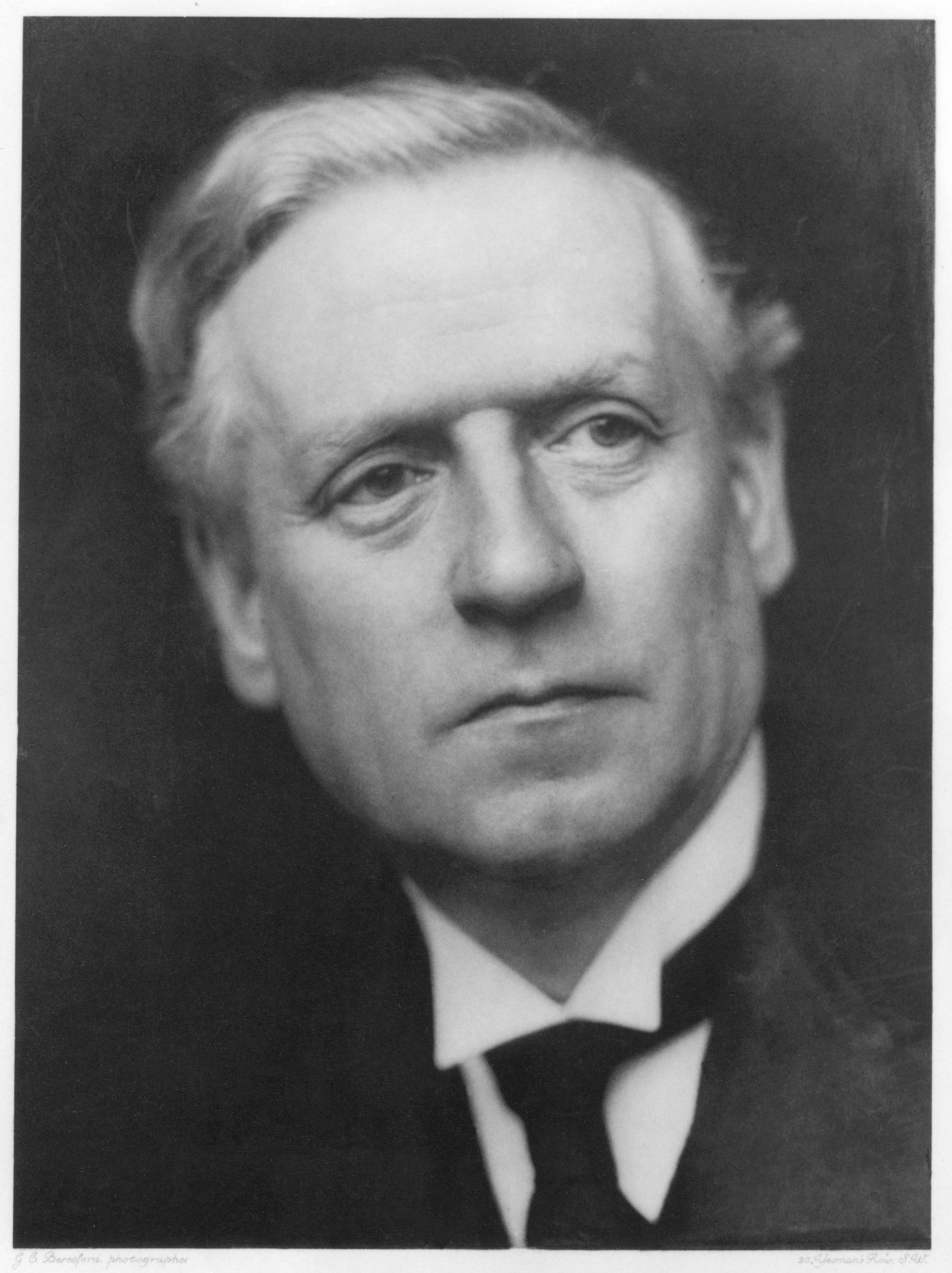
The political setting differed materially from that in which the Home Rule Bills of 1886 and 1893 had failed. The Liberal ministry that emerged from the 1910 elections relied on the Irish Parliamentary Party's votes. By then, moreover, the Parliament Act 1911 had altered the legislative position. The Lords could delay a public Bill, but once the statutory conditions were met and the measure had passed the Commons in three successive sessions, they could no longer prevent it from being presented for Royal Assent. The Irish question, which the rejection of the second Home Rule Bill had left unsettled, again became integral to the government’s parliamentary survival. It was now possible, too, that Home Rule might become law without Unionist consent in the upper House.
The measure proceeded from the familiar proposition that devolution need not involve a transfer of sovereignty. The proposed Irish Parliament was to comprise the King, a Senate and a House of Commons. The Lord Lieutenant was to remain the Crown’s representative, and executive authority was to be exercised in the King’s name through him, with the assistance of an Irish Executive Committee. Westminster was to retain its power to legislate for Ireland; the Irish Parliament was not to repeal or amend the Act from which it derived. Authority might be exercised in Dublin. Sovereignty remained at Westminster.
In institutional terms, the proposals went further than either 1886 or 1893. The Bill provided for a Senate of forty members and a House of Commons of 164 members elected from the existing constituencies. It also sought to settle the question of Irish representation in the United Kingdom Parliament. The 1886 Bill proposed excluding Irish members from Westminster. The 1893 Bill initially retained eighty Irish members with limited rights of participation. The 1912 Bill retained forty-two Irish members, entitled to take part in Westminster business without the restrictions contemplated in 1893. This addressed an awkward procedural distinction, but not the underlying objection: Ireland was to have its own legislature whilst retaining representation in Westminster.
The proposed competence of an Irish Parliament was extensive, though qualified. The Crown, foreign affairs, war and peace, defence, treaties, external trade, navigation, coinage and legal tender remained matters for Westminster. The power to impose ‘religious disabilities or privileges’, or to endow a religious denomination, was expressly withheld. The Judicial Committee of the Privy Council would determine the validity, or otherwise, of legislation made by Dublin.
An Irish Exchequer and an Irish Consolidated Fund would remain connected to London. Customs and excise were to remain Imperial revenues, and the wider financial relationship was subject to arrangements administered through the Joint Exchequer Board. Nor was administration transferred as a single body. Land purchase, old-age pensions, national insurance, public loans, tax collection and the Royal Irish Constabulary were initially reserved. The RIC was to pass to Irish control six years after ‘the appointed day’. In these matters, as in the constitutional provisions, the Bill gave Ireland an enlarged sphere of government while retaining significant powers and safeguards at Westminster.
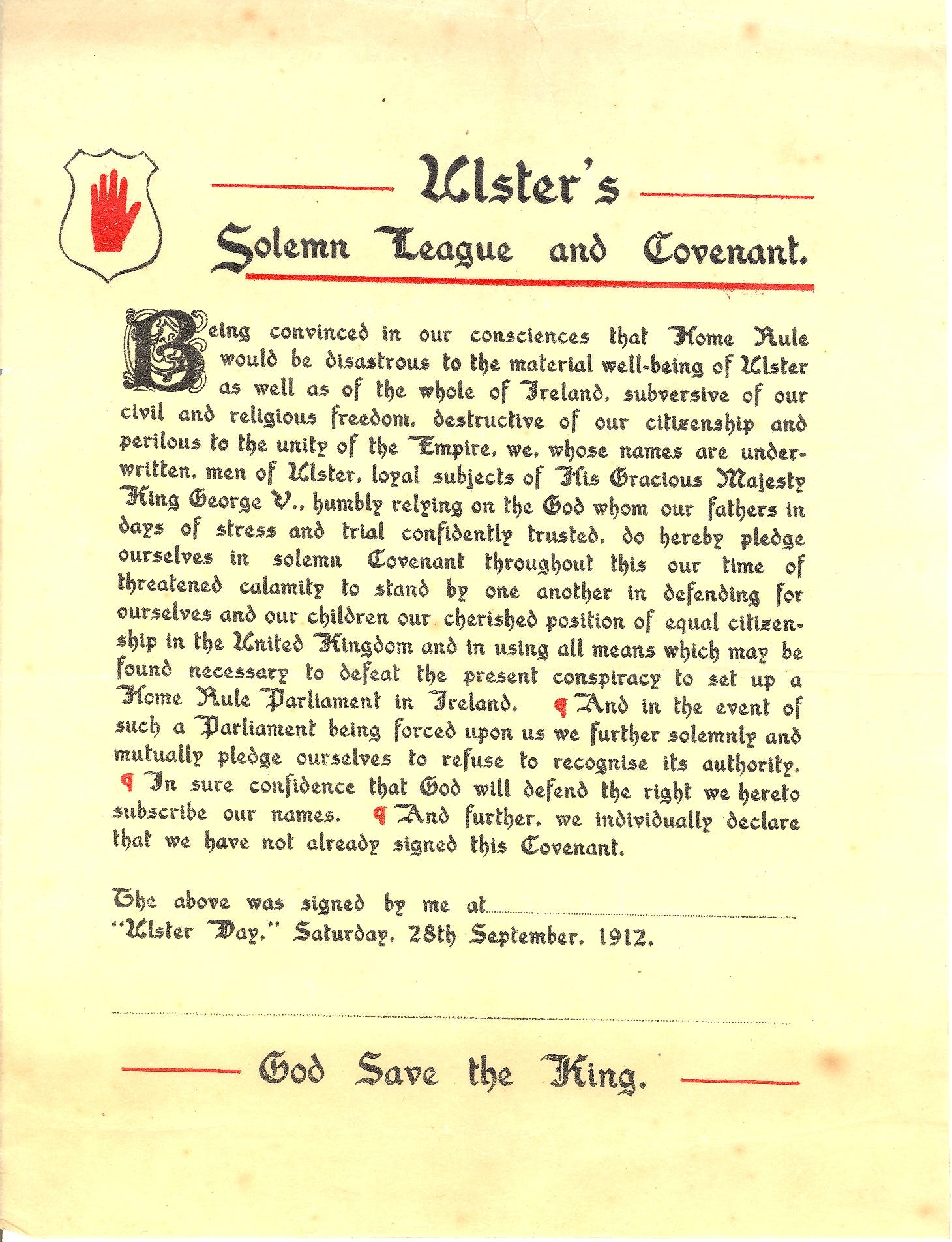
Ulster was no longer represented merely by parliamentary resistance and petition. By 1912 Unionism had acquired a more extensive organisational form. Carson’s leadership, the encouragement of the Conservative Party in Great Britain, and the growth of Unionist associations supplied a degree of co-ordination not present during the earlier Home Rule controversies. The Ulster Covenant, signed in September 1912, bound those who subscribed it to oppose Home Rule by ‘all means which may be found necessary’. The formation of the Ulster Volunteer Force gave that language an organised paramilitary expression. The prospect was therefore not simply of opposition in Parliament, but of resistance to a settlement which Westminster might enact.
Belfast occupied a central place in that resistance. Its industrial workforce, commercial institutions and Protestant Unionist leadership furnished much of its public setting and organisational capacity. That mobilisation did not encompass the whole city. Constitutional nationalism remained closely associated with Belfast’s Catholic population, and the city’s electoral and associational divisions still bore the marks of the earlier Home Rule disputes. Even so, Belfast made concrete a dispute often expressed in abstract constitutional terms. The question was not only whether legislative powers should move to Dublin, but how such a transfer would affect authority in the city itself.
No provision for the exclusion of Ulster appeared in the Bill as introduced. Yet, as the crisis deepened, exclusion became the central subject of negotiation: exclusion of Ulster as a whole, of a number of counties, or of particular counties for a defined period. The issue was not simply a matter of drawing a boundary. It involved the territory to be excluded, the period and legal terms of exclusion, the basis on which local consent might be established, and the financial, administrative and representative consequences for both parts of Ireland. By the summer of 1914, exclusion could not be avoided in negotiation, but the parties had reached no agreement on its area, duration or legal foundation. The Act that received Royal Assent contained no provision excluding Ulster.
The third Home Rule Bill passed the Commons in three successive sessions and was rejected, or deemed to have been rejected, by the Lords on each occasion. The Parliament Act 1911 had reduced the Lords’ former veto to a power of delay. The Government of Ireland Act 1914 received Royal Assent on 18 September 1914. The Suspensory Act, enacted on the same day, deferred its operation amid the present war. Home Rule had been enacted, not commenced.