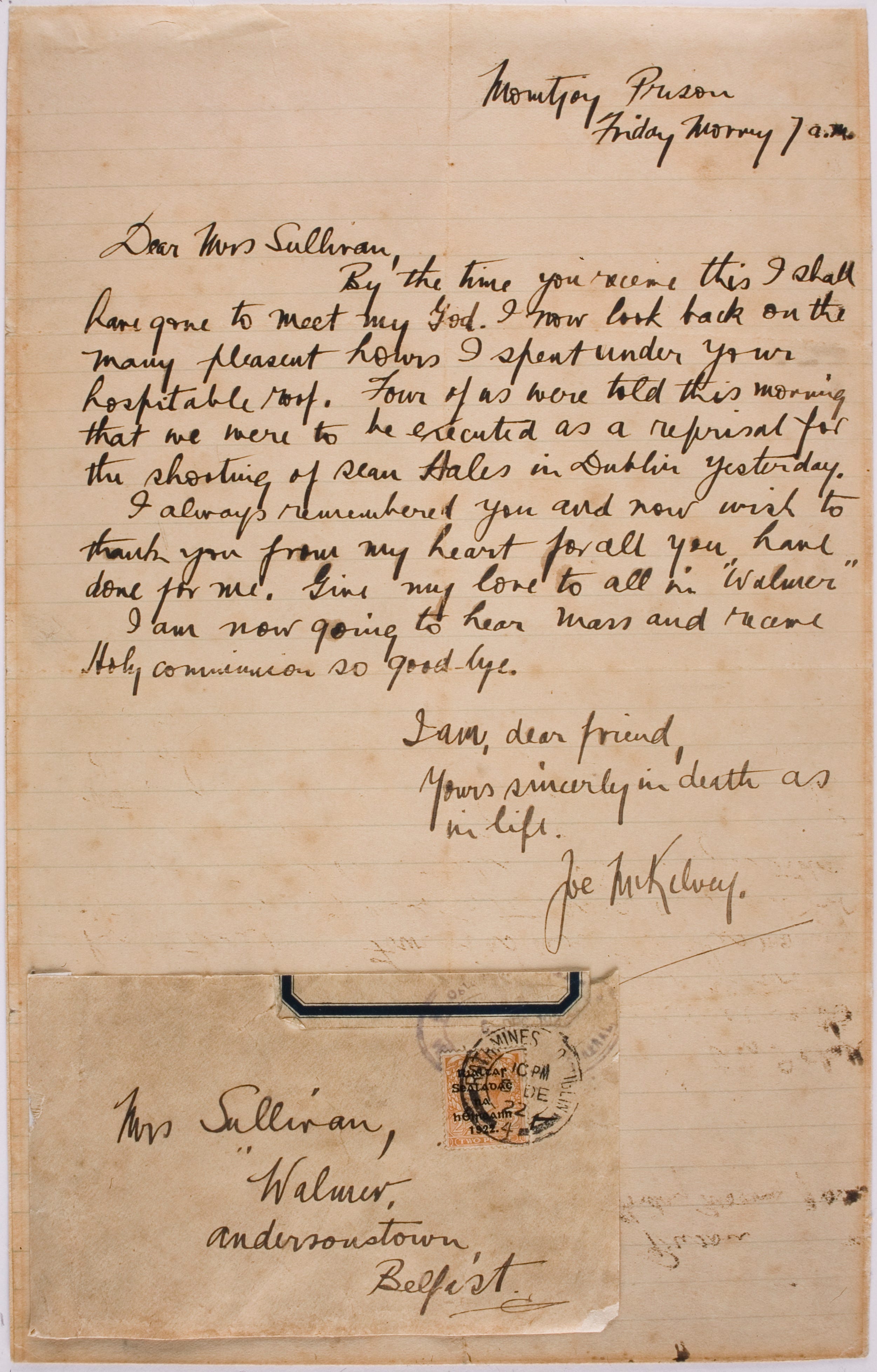
At 7 am on Friday, 8 December 1922, Joe McKelvey wrote from Mountjoy Prison to my great-grandmother, Isabella Sullivan, at Walmer, Andersonstown, Belfast. Within hours, he and three fellow prisoners – Liam Mellows, Rory O’Connor and Dick Barrett – would be executed as a reprisal for the assassination of pro-Treaty TD Seán Hales.
Joe McKelvey was born in Stewartstown, Co. Tyrone, in 1898, the only child of Patrick, an RIC constable, and his wife Rose. With the outbreak of the Great War, Patrick signed up for home service, and the family moved to Belfast. Isabella's eldest son, John, and Joe were founding members of O’Donovan Rossa GAC in 1916, with her brother-in-law (also John) as chairman. Serjeant McKelvey died in 1919 and is buried in a Commonwealth war grave in Milltown Cemetery.
In July 1921, General Eoin O’Duffy was appointed Truce Liaison Officer in Belfast, based in St Mary’s Hall and lodging with the Sullivans at Walmer. The Truce partially legitimised republican activity in the city, and the hall became its administrative centre.
The Treaty
The fourth Home Rule Bill became the Government of Ireland Act 1920, which created Northern Ireland on 3 May 1921. Mirrored provisions for Southern Ireland were rejected. Negotiations then led to dominion status under the Anglo-Irish Treaty of 6 December 1921. The six Ulster counties that formed Northern Ireland were, however, effectively off the table before negotiations began.
On 26 December 1921, Joe McKelvey and Denis McCullough met Michael Collins at the Gresham Hotel, outlining their reservations and seeking assurances on the position of northern nationalists. This sufficed to secure the Third Northern Division’s conditional acceptance of the Treaty, but McKelvey’s misgivings about the settlement and its implications for Belfast never disappeared.
St Mary’s Hall
O’Duffy’s later military limitations were offset by considerable administrative acumen. This became all too clear on 18 March 1922 when, at 9.45 pm, a whist drive was in full swing, and St Mary’s Hall was raided by the RIC and commandeered by Specials. A significant amount of documentation was seized. Collins described the raid as a clear breach of the Truce, which was already of limited effect in Belfast, where inter-communal violence persisted throughout.
McKelvey had become increasingly disillusioned and, having succeeded O’Duffy as Truce Liaison Officer, bore the brunt for the loss of St Mary’s Hall. Rather than face the fallout and likely arrest in Belfast, he fled to Dublin.
Four Courts
McKelvey was appointed to the (anti-Treaty) Army Council as deputy chief of staff to Liam Lynch and, on 14 April 1922, occupied the Four Courts. With a further split between militant and more cautious factions, McKelvey briefly became the “militant” chief of staff on 18 June.
The Provisional Government initially tried to ignore the occupation. The assassination in London of Irish-born unionist Sir Henry Wilson by English-born republicans on 22 June, however, prompted Winston Churchill to increase the pressure on it to act – or he would. The Battle of the Four Courts lasted for three days before the anti-Treaty garrison surrendered on 30 June.
A Free State
Lynch, now the “moderate” chief of staff, wrote to the Speaker of the Provisional Parliament, or Constituent Assembly, on 28 November 1922, warning of “very drastic measures” against those who had voted for what he called the “Murder Bill”. The assembly lacked full legislative competence in the absence of a governor-general; Tim Healy, Kevin O’Higgins’s uncle, would not be appointed until 6 December 1922. Nevertheless, it had passed an Army Resolution on 27 September 1922 – often inaccurately described as a public safety bill or act – to provide political cover for constitutionally dubious measures.
Day One. By the time the Free State formally came into being on 6 December 1922, Arthur Griffith and Michael Collins were already dead, and Erskine Childers had been executed by the Provisional Government for possessing a small pistol gifted by Collins.
Day Two, 2.43 pm. Pro-Treaty TDs Seán Hales and Deputy Speaker Pádraig O’Máille left the Ormond Hotel and hailed an open-topped horse-drawn taxi for Leinster House. Perhaps following a tip-off from hotel staff, a car pulled alongside and its occupants opened fire with six or seven revolver shots at close range. The jarvey drove instinctively towards O’Connell Bridge, only realising his passengers were hit when he saw blood on the cushions, and then diverted to Jervis Street Hospital.
O’Máille was shot twice, including in his spine, but survived to become a Fianna Fáil senator in later life. Hales was hit at least four times and was dead on arrival. He had not voted on the Army Resolution and was not even in the Dáil on 27 September, nor was his name on Lynch’s list of “Murder Members”; O’Máille had, and contemporary republican accounts suggest he was the intended target.
Day Two, 7 pm. The minister for local government, Ernest Blythe, later recalled that he was running late for the Executive Council meeting that evening. As he took his seat, he heard a list of names being read out and “gathered that the proposal was that they should be executed in the morning without any form of trial”. After a brief discussion, President W.T. Cosgrave called for a vote around the table. Kevin O’Higgins was hesitant before agreeing: “Take them out and shoot them.” The decision was unanimous.
There was, of course, no discussion of names by the Cabinet. The names presumably were selected by Army officers as those of men whose execution would be most calculated to have the maximum warning effect on members of the Irregular forces in all parts of the country. Personal feelings did not come into it at all.
This may have inspired the post hoc hypothesis that the four were selected as one from each province. As a party to the decision, even Blythe did not know. The selection of McKelvey, Mellows and O’Connor related more to their seniority and, for Barrett, notoriety, than to geography; all were IRB men who knew too much.
Day Three, 3 am. The erstwhile go-lucky four were awakened in their cells and told that they were to be executed as a reprisal for the assassination of Seán Hales. Joe wrote his goodbyes to Rose; his later letter to Mrs Sullivan was a thinly veiled farewell to his remaining friends in Belfast.
Day Three, 9.20 am. A prison chaplain, Fr John Pigott, later recalled how the sign was given, the volley rang out, and the men fell. There were two officers on hand “to put out of pain anyone not already dead”. “McKelvey, who was conscious, needed attention and I heard him call out ‘give me another’, ‘and another’, and then there was a silence – a great silence.”
Day Three, 4.30 pm. The inquest jury found that Hales had died from a bullet wound through the heart inflicted by “persons unknown” and declared those responsible guilty of wilful murder.
Day Three, 6 pm. The executions were debated in a deeply polarised Dáil, with the fledgling government defending its actions as a necessary reprisal to protect the State, and its opponents condemning murder without trial and betrayal. O’Higgins exclaimed: “Personal spite, great heavens! Vindictiveness! One of these men was a friend of mine.” Rory O’Connor had been his best man in October 1921.
There was little pretence of legality. The executions, one of the first significant acts of the Irish Free State, were explicitly carried out as a reprisal. Both sides claimed the other to be worse than the British had ever been. Leader of the Opposition, Thomas Johnson TD, described both Hales’s assassination and the State’s reprisals as murder. The Hales family, divided by the Treaty, were united in grief in expressing their horror and disgust at the reprisal executions, which, they feared, would only deepen bitterness and delay reconciliation.
Murder by any definition
General Richard Mulcahy’s son, Risteárd, later noted that his father never expressed regret about the executions. Joe McKelvey’s remains were not released to Rose until October 1924 and were then reinterred in the Harbinson plot in Milltown Cemetery, 100 yards from his father.
In 2011, Leo Varadkar TD said of the Mountjoy reprisals: “It was an atrocity and those people killed without a trial by the first Government were murdered.” In 2022, Micheál Martin TD similarly described the executions as “murder by any definition”.
Legacy
The Military Service Pensions Collection records Dick Barrett as having been executed in Mountjoy “after sentence of death by a Military Court” while on military service. His mother applied under the Army Pensions Act 1932; his service and death in service were certified, and the Board recommended the maximum dependants’ gratuity of £112 10s, while a parallel claim by his sister Mary O’Neill was rejected.
Liam Mellows’s mother, Sarah, missed the original deadline for claims and instead waged a long letter-writing campaign with government departments, De Valera and successive ministers, until the legislation was amended. In 1941, she was deemed partially dependent, receiving the gratuity and later a modest annual allowance until her death in 1952.
Rory O’Connor’s mother, Julia, and his sister, Helen, also applied, including representations on Helen’s behalf from Liam Cosgrave TD. Julia was found to be partially dependent and received the gratuity, but Helen was not initially considered a dependant. Reapplying in 1969 as “an unmarried woman in her nineties with very limited means”, she was finally recognised as a dependant, with an allowance of £246 per annum until her death less than two years later.
There was no application from the family of Lieutenant-General McKelvey. Rose died alone in 1927. She is buried 50 yards from her husband and 150 yards from her son. To paraphrase Martin Niemöller, there was by then no one left.
This article is forthcoming in History Ireland.
Further reading
Eamon Phoenix, Northern Nationalists (1994) (Belfast: Ulster Historical Foundation)
John Dorney, The Civil War in Dublin (2017) (Dublin: Merrion)
Seán Enright, The Irish Civil War (2019) (Dublin: Merrion)
Alan F. Parkinson, A Difficult Birth: The Early Years of Northern Ireland 1920–25 (2020) (Dublin: Eastwood)


