
That the 2/58th was in Portugal at all reflected a statutory interpretation beyond the spirit of their bargain. By the close of 1809, the battalion was, however, adjusting to its new environment, with hospital and detached entries becoming the norm in its muster logs. Wellington’s assumption of command converted Cradock’s defensive concentration around Lisbon into a forward posture from which the long campaign would be conducted, while Beresford’s reorganisation of the Portuguese army provided the additional numbers he needed. Within that composite Anglo‑Portuguese force, the 2/58th formed an ordinary, integral part of the field army far removed from home service.
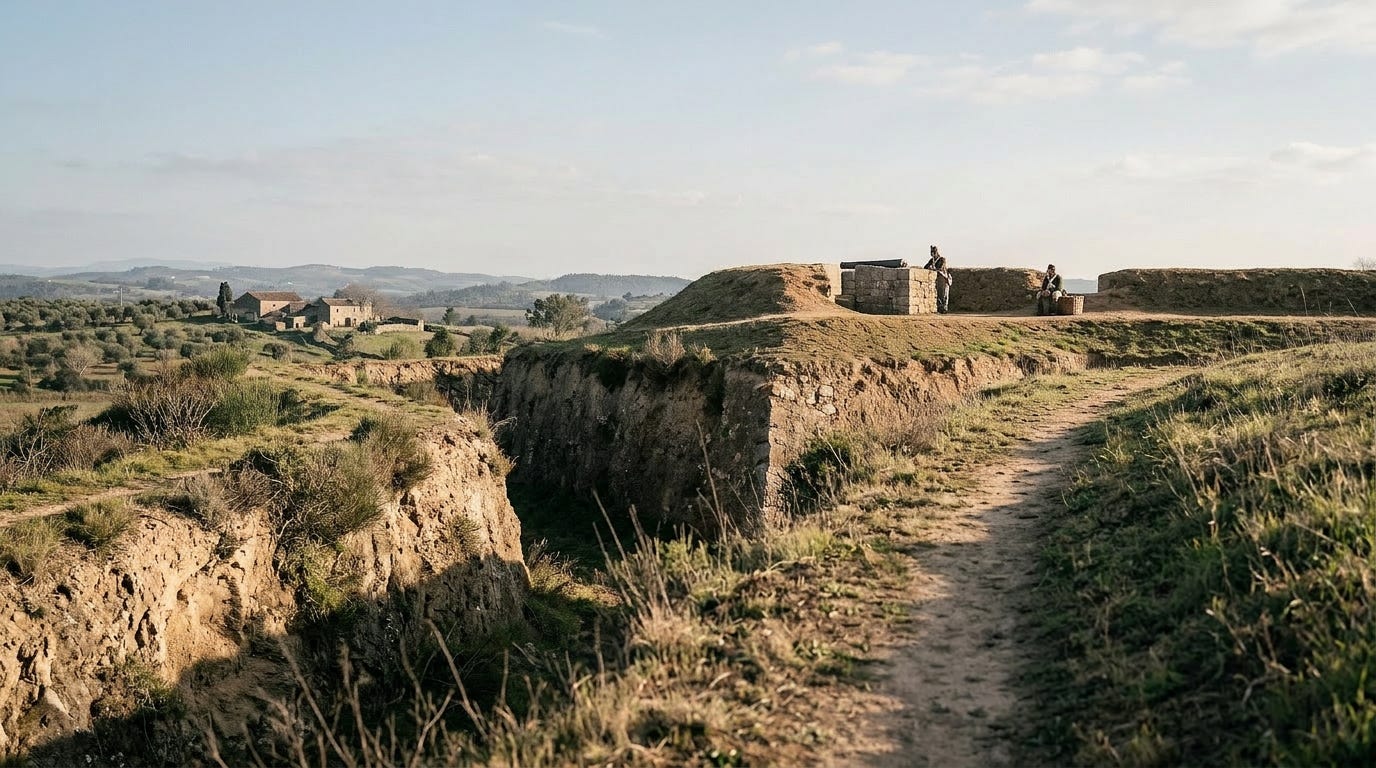
Wellington’s strategy rested on three pillars: Beresford’s reconstituted Portuguese army, a scheme of devastation, and the Lines of Torres Vedras. His second instrument – devastation – was designed and disseminated in anticipation of a French advance towards Lisbon and required the rural population to withdraw with their movable property and to destroy anything left behind, including supplies, mills and food to forage. Third was a continuous network of fortifications and fieldworks constructed across the peninsula to the north of Lisbon. Thousands of Portuguese labourers were tasked by British engineers with their construction, cutting into the hillsides and filling the ramparts and ditches, the soil excavated, broken and sieved before being tamped back into parapets dense enough to absorb and blunt cannon‑shot.
The Lines would eventually comprise three successive chains of fortification, spanning 50–60 miles across the peninsula between the Tagus and the Atlantic, with 152 distinct forts mounting around 600 guns. By October 1810, over 120 of these were already manned and defensible, each designed for 200–300 men and up to six guns, and connected by roads cut into the earth to enable rapid lateral movement. The project came in at under £200,000, an outlay equivalent to a year’s pay for a single division.
The third French invasion arrived in front of the Lines in October 1810. Under Marshal André Masséna, commanding Napoleon’s Army of Portugal, up to 60,000 troops, already weakened by the battle of Bussaco, marched through the barren countryside of devastation: Wellington’s strategy in practice. Beresford’s army gave depth in numbers and allowed the Anglo‑Portuguese line to be held without thinning the garrisons behind it. Devastation to the north of Lisbon left Masséna with only limited scope to forage and without any secure supply of his own, his columns pushed ever farther afield for food and forage while the Anglo‑Portuguese army drew steadily upon the protected magazines of the capital. The Lines themselves, well‑resourced from the maritime city behind, presented an entrenched position which he ultimately judged too strong to be directly assailable.
Masséna, committed to a position he could neither hold nor provision, saw his army erode from hunger, disease, and the winter of 1810–11. In March 1811, he withdrew into Spain. The three instruments — devastation, national mobilisation and the great defensive lines — had worked together as intended, each incomplete without the other two. Masséna’s losses to this strategy exceeded those he suffered in any pitched battle in Portugal.