
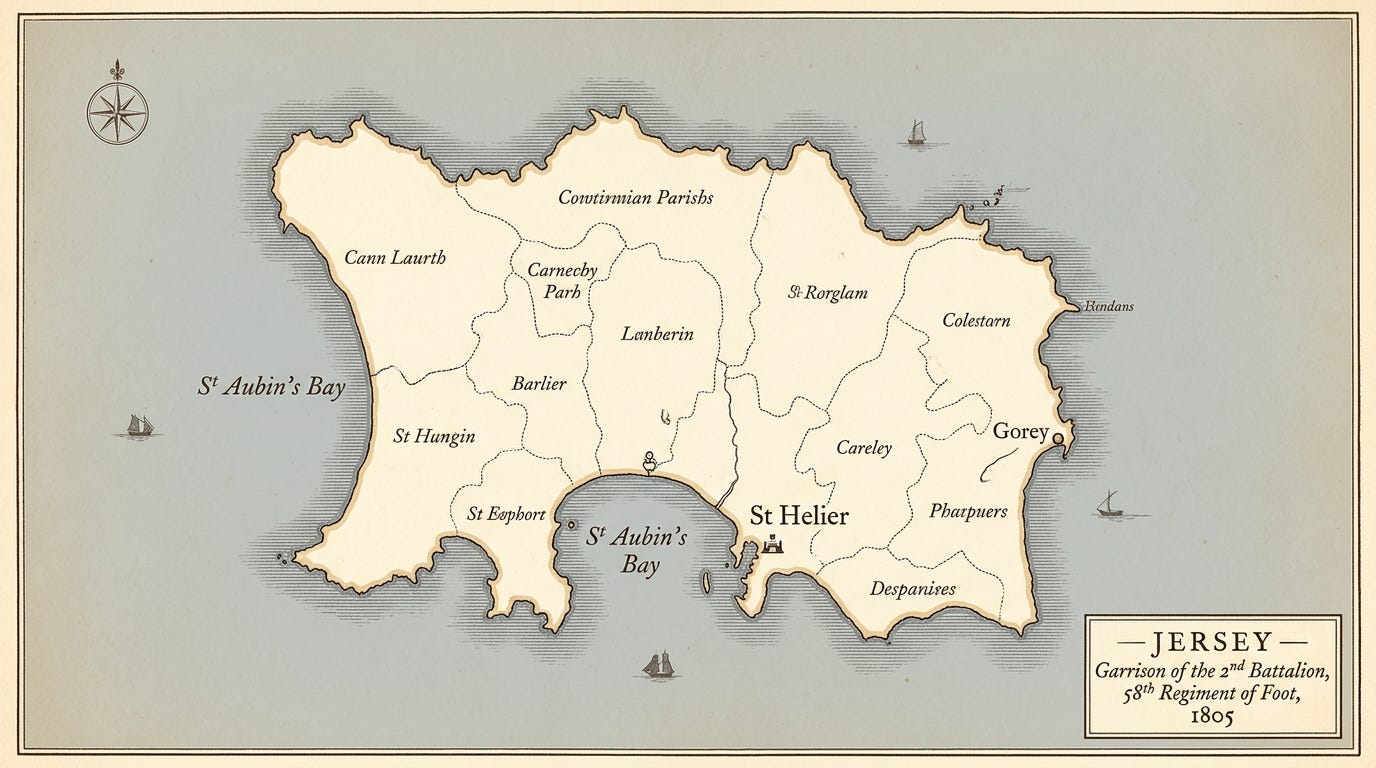
We next meet Jeremiah Sullivan on the record in the third quarter of 1805 as a private soldier garrisoned in the Channel Islands, his name entering the 2/58th muster book at St Helier with a full period of pay and no entry of absence or irregularity. In the War Office returns for that and the subsequent quarters, his name is carried without interruption in the muster tables of the 2/58th, and, given the battalion’s settled posting, he may be treated as serving continuously as part of the Jersey garrison, even if brief, unrecorded absences can be neither confirmed nor denied.
For Jeremiah, they show no transfer to another regiment, no notation of desertion, court‑martial or discharge, and no extended period of hospitalisation during his Jersey years; what they present, rather, is the unremarkable continuity of a private soldier whose service, in administrative terms, raised nothing of note beyond his inclusion in the battalion’s effective strength. In the same sequence, other men are annotated as “Unfit for Service” or detached on recruiting duty in England and Ireland, but Jeremiah’s own entry is consistently “present” at St Helier, without such qualification. By 1808, the musters have him expressly allocated to company 8, with two quarters also noting he was “On Duty”, indicating, at least at those muster points, he was neither in hospital nor elsewhere.
Jeremiah’s years in St Helier were defined by a mundanity that belied the island’s living history of military incursions. A French force had landed and briefly occupied St Helier in January 1781, and the lesson that the island’s proximity to the Normandy coast rendered it acutely vulnerable to assault had been institutionally absorbed without being entirely resolved. With the resumption of hostilities in 1803, and the concentration of French forces along the facing coast, Jersey was again judged to be exposed: close enough to France to be raided, of sufficient commercial importance to defend. Placing the 2/58th on Jersey was part of a wider policy of home‑defence designed as a deterrent for cross‑Channel assault through a combination of coastal fortification and the visible, recorded presence of line infantry on the island.
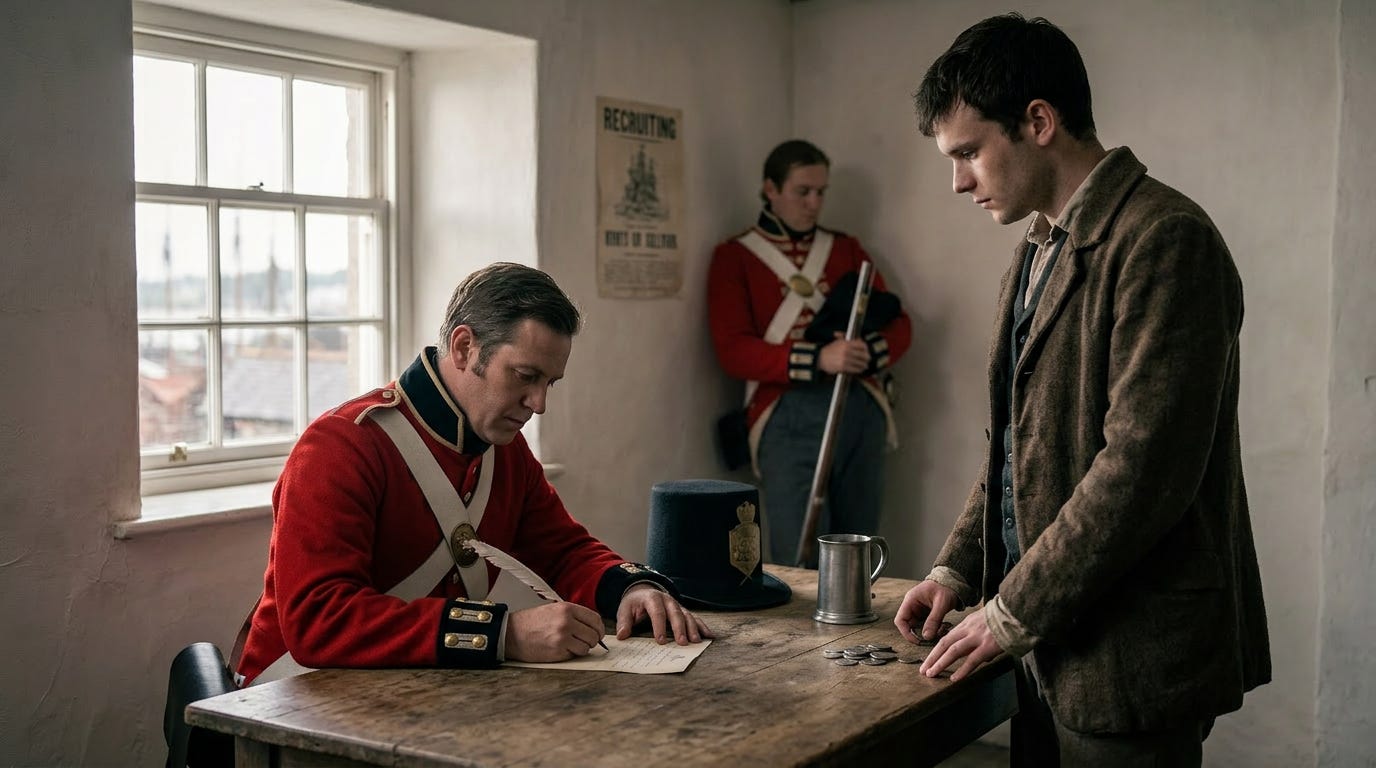
For a private soldier in the 2/58th, the daily rate of pay was notionally one shilling. Stoppages for clothing, rations and other necessaries could reduce this sum to just a few pence, not dissimilar to what might have been earned in casual labour on the quays of Cork. Garrison life meant shared accommodation, regulated movement and the constant supervision of officers whose authority over a soldier’s time and body was backed by a disciplinary code that permitted sanctions up to and including corporal punishment. Enlisting “for life” was more than a simple undertaking to serve for an indefinite period: it took an otherwise ordinary civilian subject and recast them as just another number embedded within a distinct military jurisdiction, documented in the continuous lines of the muster tables that record unbroken compliance.
By Q2 1809, the War Office returns still carry Jeremiah in the ranks of the 2/58th. His battalion had, however, by then moved beyond its Channel Islands garrison role: the same muster sequence that documents his unbroken service on Jersey also marks the point at which the regiment left the island and was redeployed to an entirely different theatre.