
Raised in 1755 by Colonel Robert Anstruther and re‑ranked as the 58th Regiment of Foot two years later, the ‘Rutlandshire’ tag was acquired in 1782. Although this may naturally point towards the English Midlands, it was more of an administrative mechanism to assist with recruitment than any point of geographical reference. Before a second battalion was ever raised, the 58th had compiled a respectable imperial record, serving in North America, the West Indies, Minorca, Gibraltar, Malta and Egypt. They wore black facings – the collar and cuffs of the scarlet coatee set in black velvet – in accordance with the clothing and ‘facings and lacings’ regulations issued by Royal Warrant in 1768, which standardised uniform details by regimental number and, in the 58th’s case, underpinned the later sobriquet referencing their Black Cuffs.
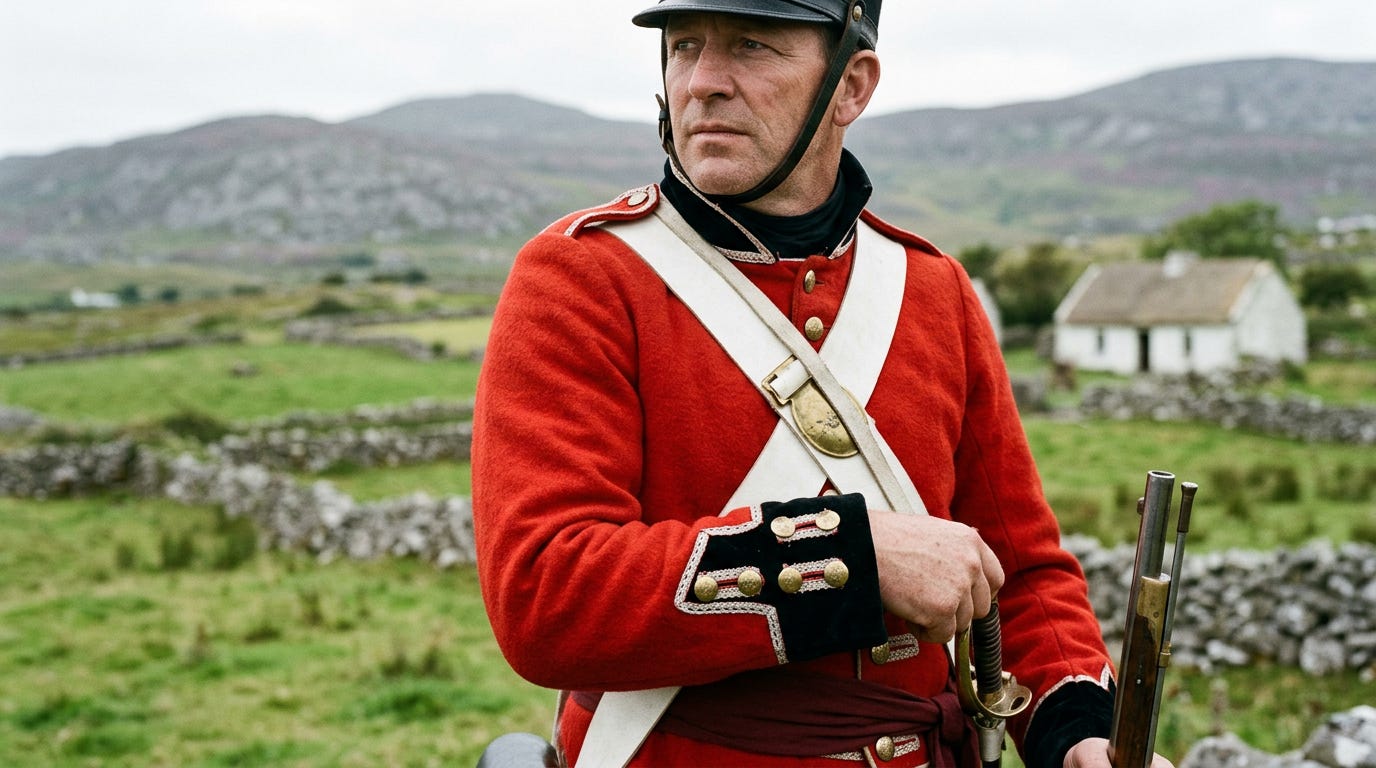
The 2nd Battalion was formed at Kinsale, County Cork, on 28 August 1803 from the Irish Army of Reserve, just as the fear of a Napoleonic invasion was at its height. Their numbers were later supplemented by drafts raised under the Additional Forces Act 1803 from Cork and Kerry. Further intakes in 1806 extended recruitment beyond Munster and across the island. By the time the 2/58th reached Jersey, and Jeremiah Sullivan appeared on the muster roll at St Helier, their composition, if not their cuffs, was more of a really dark green.
On the face of the statutes, the premise was strictly limited: the legislation was framed as an emergency provision ‘for the more effectual Defence and Security of the United Kingdom’. The Government repeatedly insisted that the Army of Reserve and the Additional Forces were to be engaged for home service only. The Army of Reserve was to be raised by county ballot, with a quota for each county in Great Britain and Ireland; the Additional Forces Acts allowed for voluntary enlistment on a similar basis, with bounties offered to assuage resentment of the ballot and to render the taking of the King’s shilling that bit more palatable.
The Militia (Ireland) Acts already required parishes to either furnish the required numbers or raise money by local levy, with county quotas enforced by parish ballot. In practice, that burden was passed down to otherwise unskilled labour, whereas those of means could pay the commutation rates. Against that background, the Reserve and Additional Forces legislation was presented as a straightforward bargain: a bounty and an obligation to serve within the United Kingdom under a threat of invasion, rather than an open‑ended pledge for service overseas.
In practise, its operation was less straightforward. The legislation expressly provided for additional bounties to be paid to men who volunteered from the Reserve and associated forces into the regular army. The administrative mechanisms of the War Office rendered such transfers the expectation, rather than an exception. Fortescue’s characterisation of the Army of Reserve as a ‘net to catch men who could then be transferred to the line’ reads as more than retrospective rhetoric: it reflects the logic of the legislative draftsman, and with it a broad interpretation of the home service covenant.