
The Anglo-Irish Treaty promised peace. In Belfast, that promise was met with cynicism. For unionists, Home Rule IV had already resolved the Irish question. For nationalists, the terms agreed under the Treaty challenged that resolution.
On 11 January 1922, Sir James Craig wrote to the Colonial Secretary, Winston Churchill. His typed address “Cabin Hill, Knock” appeared above an embossed “Belfast, Ulster” on the letterhead. “I learn from Sir Hamar Greenwood [Chief Secretary for Ireland, 1920-22] that you have been appointed Chairman of the Committee of the Cabinet dealing with Irish affairs.” Craig expressed his difficulties with the terms of the Treaty, specifically the provision for a Boundary Commission, over which he had not been consulted. The term Ulster was used interchangeably with Northern Ireland, and seemingly without irony. He stated that the Prime Minister, Lloyd George, and Austen Chamberlain [Lord Privy Seal and Conservative Party leader] had assured him that “Ulster will participate in any arrangements which may be come to with Southern Ireland according her special consideration.” He indicated a willingness to meet with the Provisional Government to “ascertain clearly whether the policy of Southern Ireland is to be one of peace, or whether the present methods of pressure on Northern Ireland is to be continued” whilst cautioning that continued “I.R.A. methods” must lead Northern Ireland to adopt “counter measures”.
Churchill brought the matter to his Cabinet committee and, within days, arranged a meeting between Craig and Michael Collins at his London office. Although their host later described the encounter as beginning in glowering silence, they swiftly reached an agreement:
1. Boundary Commission: “The Boundary Commission as outlined in the Treaty to be altered. The Governments of the Free State and of Northern Ireland to appoint one representative each to report to Mr. Collins and Sir James Craig, who will mutually agree on behalf of their respective Governments on the future boundaries between the two.”
2. Belfast boycott: “Without prejudice to the future consideration by his Government on the question of tariffs, Mr. Collins undertakes that the Belfast boycott is to be discontinued immediately, and Sir James Craig undertakes to facilitate in every possible way the return of Catholic workmen - without tests - to the shipyards as and when trade revival enables the firms concerned to absorb the present unemployed. In the meantime a system of relief on a large scale is being arranged to carry over the period of distress.”
3. Railways: “Representatives of both Governments to unite to facilitate a settlement of the railway dispute.”
4. Council of Ireland: “The two Governments to endeavour to devise a more suitable system than the Council of Ireland for dealing with problems affecting all Ireland.”
5. Prisoners: “A further meeting will take place at a subsequent date in Ireland between the signatories to this agreement to discuss the question of post-truce prisoners.”
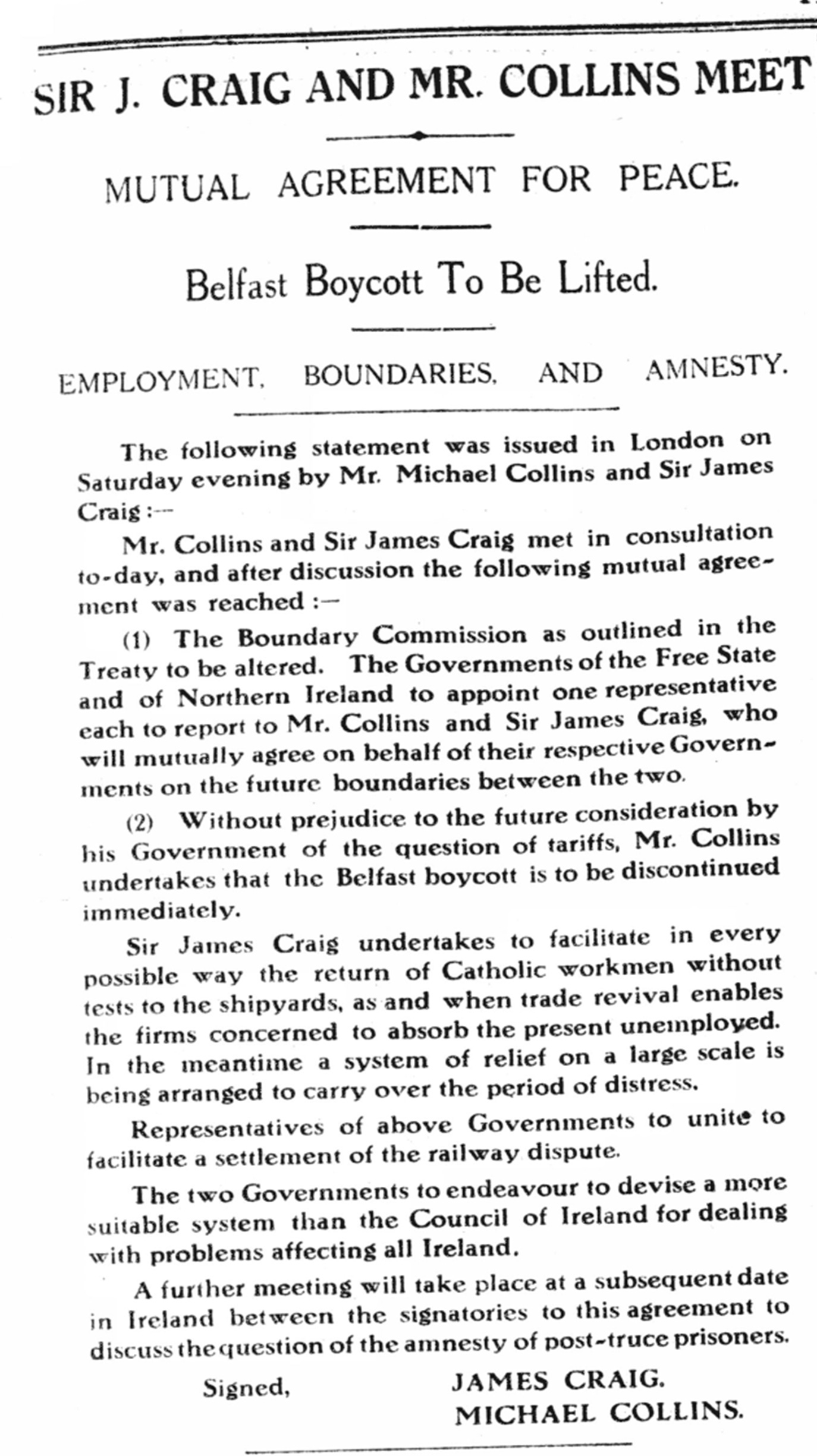
The Belfast News-Letter led with the ending of the boycott and the return of shipyard workers, with the boundary to be settled later “by mutual arrangement”. In Dublin, the Irish Independent welcomed “the foundations of an all-Ireland parliament”. In Belfast, the Irish News placed particular weight on the two governments’ recognition of each other and the prospect of practical cooperation. For the Northern Whig, the text of the “Mutual Agreement for Peace” was reproduced under a subheading of employment, boundaries and amnesty.
A hasty agreement on boundaries, trade, and employment, the document fell silent on inter-communal violence, checks and balances. Perhaps shaped by the conflicting assurances of Lloyd George’s government, Craig and Collins differed fundamentally in how they understood what had been agreed. For Craig, no significant reduction in territory; for Collins, a significant transfer of land. On trade, the Provisional Government no longer had the final say on ending the Belfast boycott. On employment, the undertaking to facilitate “in every possible way” had, by the end of the month, facilitated the return of just twenty workers out of an estimated seven thousand expelled. These fundamental differences were all too apparent when they met again in Dublin on 2 February 1922, with no further agreement.