
By the spring of 1813, attrition had significantly reduced the 2/58th. Six companies were sent home to recruit, while the remaining four were absorbed into a 3rd Provisional Battalion within Lieutenant‑General Sir Thomas Picton’s 3rd Division.
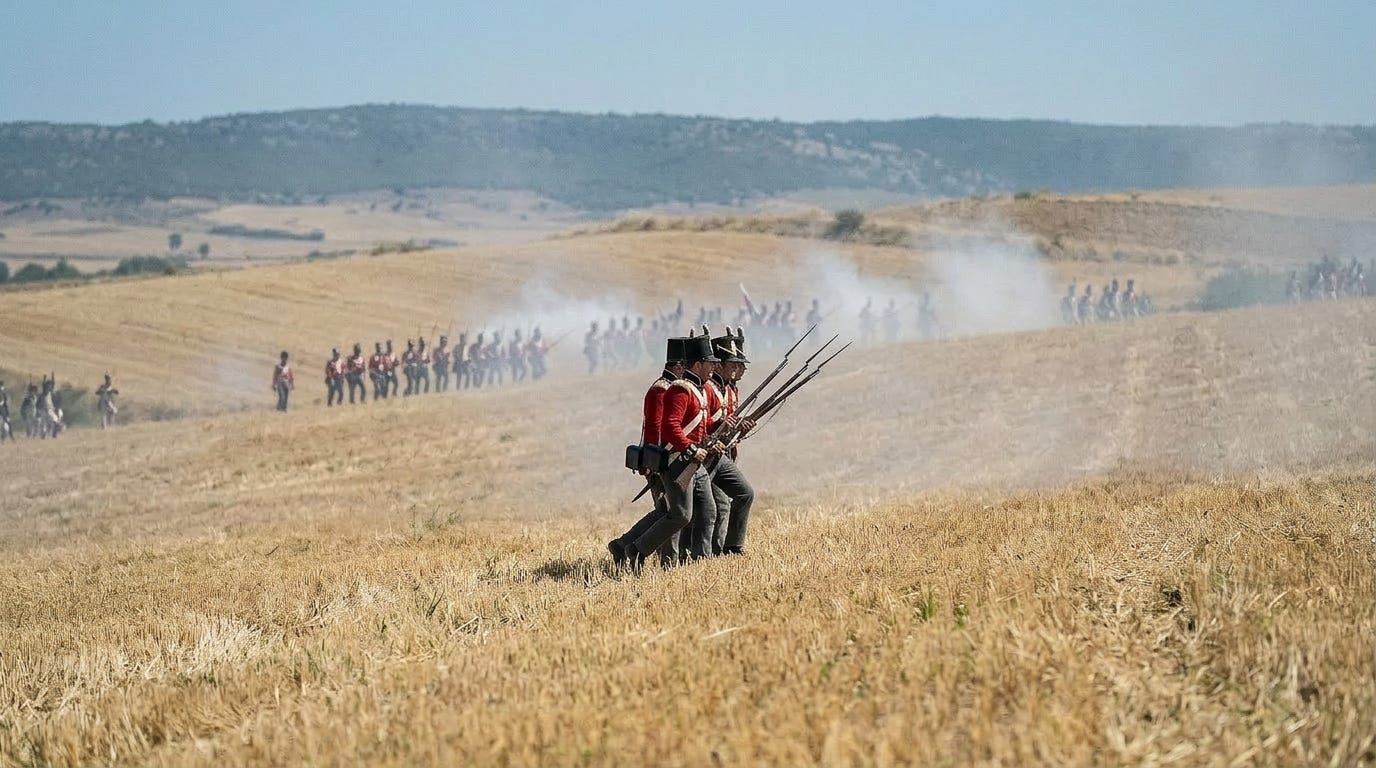
On 21 June 1813, the army of Joseph Bonaparte, Napoleon’s elder brother and, from June 1808, Joseph I, King of Spain and the Indies, stood near Vitoria, in northern Spain on the road between Burgos and the Pyrenees, in anticipation of an Anglo-Portuguese‑Spanish assault from the west. Wellington actually advanced simultaneously in four columns from the north, south and west, with the 2/58th now forming part of the 7th Division under Lieutenant‑General the Earl of Dalhousie in the brigade of Major‑General Barnes. Within that brigade, its four companies served alongside those of the 2/24th, their individual identities preserved only in the muster tables, which record them as fractions of a temporary whole. By early afternoon, the French position was no longer tenable, and the battle ended in their retreat towards Pamplona, leaving behind guns, baggage and much of the plunder accumulated during the occupation of Spain. Joseph’s army is usually reckoned to have lost around 8,000 men, while Wellington’s casualties approached 5,000.
For Southey, this was the decisive end of French control in Spain: the point at which Joseph’s authority on the Peninsula effectively collapsed. Napier is more critical in noting, despite the scale of the defeat, that the pursuit was not pressed with the energy that might have destroyed Joseph’s army outright.
After Vitoria, Napoleon appointed Marshal Jean‑de‑Dieu Soult as his brother’s successor, charged with reorganising and leading the French forces south of the Pyrenees. Soult’s attempt to restore the French position produced a series of hard actions in the mountain passes, which Oman reads as evidence that Wellington’s advance could only be kept in check by a sustained counter‑offensive rather than by any stable defensive line. By the autumn of 1813, San Sebastián had fallen, Pamplona was isolated, and Wellington’s army had crossed the Bidassoa into France, turning what had begun as a campaign to expel a foreign king from Spain into an invasion of metropolitan French territory.
Confrontations in France at the Nivelle, the Nive and Orthez culminated in the battle of Toulouse on 10 April 1814. Oman and Southey both stress that these actions were bitterly contested, with the French defending on their own soil with a resolution that was often absent in the later stages of the Spanish campaign. Napier emphasises the cumulative effect of the weather, ground, sickness, and repeated engagements on battle-fatigued French battalions. Napoleon abdicated two days later.