
On 21 August 1898, Maurice Sullivan, bachelor, of 29 Plevna Street, Belfast, walked down the aisle at St Peter’s with Isabella Letson, nineteen, spinster, of 4 Conway Street. Under “Rank or Profession of Father,” Thomas Sullivan was recorded as “Painter”; John Letson as “Dead”.
The couple were living with Isabella’s mother when their first child, John (1899–1973), was born on 28 May 1899. He may have been named for his maternal grandfather, who had died there the previous year, aged fifty-one. Marianne Letson (née Heyburn) (1838–1915) placed a notice in the Irish News: “The remains of my beloved husband will be removed … for interment in Milltown Cemetery, on this day (Monday) 14th [March], at two o’clock. Friends will please accept this intimation. American and Australian papers please copy.”
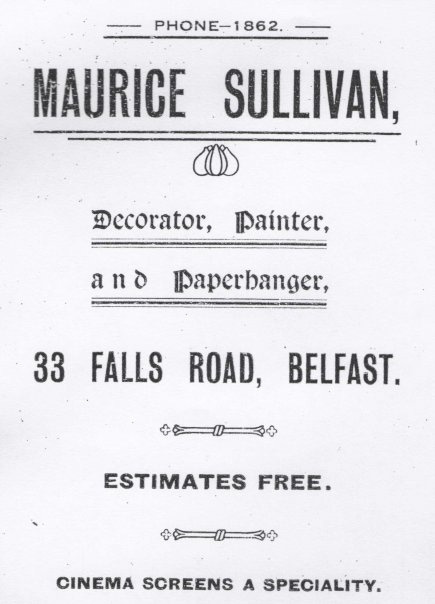
The family were living above the shop at 33 Falls Road when my grandfather, Maurice James Sullivan (1901–1982), was born on 5 May 1901. His siblings — Mary Ann (1904–1907), Thomas Vincent (1906–1990) and Henry Denis (1908–1924) — were all born there too. Mrs O’Neill kept the public house next door, while Bernard Hughes — a grandson of Barney Hughes and a miller with the family firm — lived on the other side. Beyond him, Clonard Printworks printed, bleached and finished linen and calico. Farther up the road stood St Finian’s School and the nursing convent of the Bon Secours sisters. A short walk towards town brought Maurice to the Corporation Baths, where the trade unionist Alexander Bowman (1854–1924) became superintendent that year. By 1907, the Christian Brothers had taken Hughes’s place. The Carnegie Branch Library opened a few doors up in 1908; the Clonard Picture House followed opposite in 1913, with its screen painted by one of the shareholders, Maurice Sullivan.
This was the heart of artisan west Belfast. It was also a place where faith and family, work and recreation, had become increasingly connected to the constitutional nationalism organised by Joseph Devlin (1871–1934) and the United Irish League (UIL).
The Representation of the People Act 1884 extended the parliamentary franchise; the Redistribution of Seats Act 1885 recast the constituencies. Belfast, formerly a unified constituency with two members, became four single-member divisions. In the new West Belfast division, where Catholic and Protestant electoral strength was finely balanced, contests were closely fought.
Support for Home Rule had existed in Belfast since the early 1870s, and Fenianism had been strong before that. Despite this, Catholic electors had hitherto been willing to return Presbyterian Liberals to Westminster. The election of T. M. Healy (1855–1931) for Monaghan in 1883 was one indication of a growing preference among nationalist voters for explicitly nationalist representation rather than Liberal allies. In the general election of 1885, Thomas Sexton (1847–1932) contested West Belfast and lost, in a closely fought election, by thirty-seven votes, despite the efforts of his supporters, among them the fourteen-year-old Devlin. By nineteen, Devlin was on the committee of the Belfast branch of the Irish National League. Following the Parnell split, he became secretary of the local branch of the anti-Parnellite Irish National Federation and began his long association with John Dillon (1851–1927).
By October 1901, newspaper reports already connected Maurice Sullivan with constitutional nationalism in the constituency, recording his attendance at UIL meetings through the decade. In August 1907, Margaret Lennon and Charles M’Mullan were killed during disorder associated with the Belfast dock strike. Devlin inaugurated a relief fund for their families, to which Maurice contributed ten shillings. By January 1910, Maurice was honorary treasurer of the West Belfast branch of the UIL; his participation continued into 1912.
For Maurice, recreation meant association football: ‘Paradise’ and Belfast Celtic. Founded in August 1891 by men associated with the junior clubs Milltown, Millvale and Clondara, the new side was established ‘on the same lines as the celebrated Glasgow Celtic’, whose patronage was subsequently sought. Belfast Celtic began as an ambitious junior association seeking admission to the organised senior game.
In 1901, Belfast Celtic was incorporated as a limited company and acquired a ten-acre site on the Donegall Road. A journalist had previously described Glasgow Celtic’s move to Parkhead as a journey ‘from the graveyard to paradise’. The borrowed name stuck to the Belfast ground. Paradise hosted athletics, cycling and trotting as well as association football and, in 1905, became the first ground in Ireland to provide covered accommodation.
Back to the archives, the same newspapers record Maurice Sullivan as a football administrator. In May 1908, the Irish Junior Association adopted a new constitution under which County Antrim could elect four representatives to its governing body. One delegate observed that Belfast Celtic had never been represented. Maurice Sullivan, “Celtic 2nd”, was nominated in the interests of “fair play all round”. He received three votes. The report acknowledged that the chairman and secretary had sought to give the club ‘a fair show’, while attributing the outcome to the Association’s ‘tainted environment’ and the absence of ‘equitable treatment for all’.
Further press reports in 1910, 1912 and 1913 identify Maurice in junior football’s administration, representative selection and fixtures. In March 1914, he travelled to Glasgow as a member of an Irish junior-football party. When the Irish Intermediate League was founded in 1915, Maurice was appointed vice-chairman.
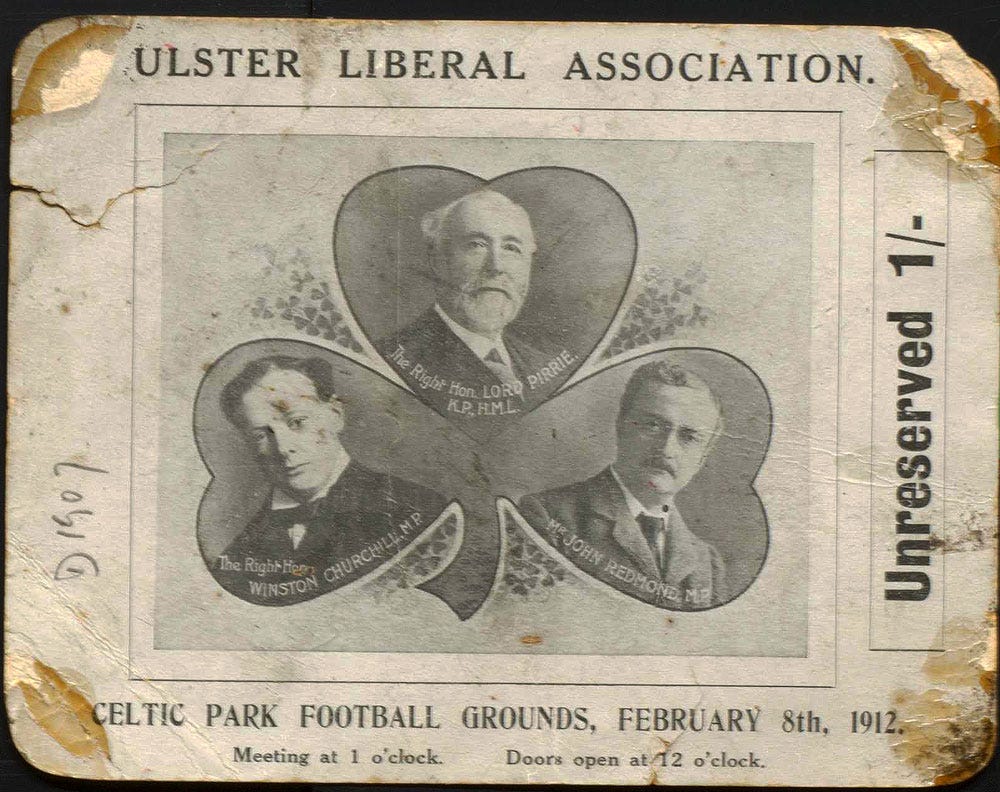
On 8 February 1912, the various strands of Maurice Sullivan’s life beyond 33 Falls Road combined. Winston Churchill, First Lord of the Admiralty, travelled to Belfast to speak for Home Rule alongside John Redmond, leader of the Irish Parliamentary Party. The intended venue was the Ulster Hall, where Churchill’s father, Lord Randolph, had given unionism the phrase, ‘Ulster will fight and Ulster will be right’, in opposition to the first Home Rule Bill. Churchill had written to Redmond on 13 January that he wanted Belfast to be a place of ‘discussions’ rather than ‘demonstrations’. Unionist opposition was, however, immediate and determined, and the hall became unavailable. An alternative venue was secured at short notice: Paradise.
Churchill was consistent only in his pragmatism. Two days before the meeting, he and Lloyd George had moved a formal Cabinet proposal for the exclusion of Ulster from the draft Bill. Two days later, he would speak for an Irish settlement in which Protestant interests might be safeguarded, but Ulster could not prevent Home Rule for Ireland as a whole. The positions were not irreconcilable: exclusion might be treated as the price of securing an Irish legislature.
Placards proclaimed “Mr Churchill for Paradise”, while the ground’s boxing ring prompted jokes about an impending contest. This did little to relieve the tension. Additional police were drafted in from Scotland. Churchill and Clementine arrived in Belfast at 8.40 a.m., were met with hostile booing, and made their way to Paradise through crowds under substantial police protection.
The anticipated disorder did not occur. A contemporary nationalist account placed the audience at 8,000 Home Rulers; Redmond described Churchill’s reception as ‘exceptionally warm’. In his address, Churchill contended that Irish self-government could be reconciled with the unity of the United Kingdom and Empire. He rejected the proposition that Ulster possessed a veto over Home Rule, while presenting constitutional safeguards for Protestant interests as compatible with an Irish settlement. The Cabinet proposal two days earlier did not warrant a mention.
The speech did not, however, alter unionist opinion. Instead, it formed part of the growing case that Home Rule would leave Ulster Protestant-unionists subject to a Catholic-nationalist majority.