
By 1850, the town of Belfast was on the brink of becoming more. Growth in the first half of the century had been driven by cotton; the next phase would be shaped by industry, demography and territory. Cotton gave way to linen. Shipbuilding, engineering and a developing commercial port connected Belfast to markets far beyond Ulster and to the wider economy of the United Kingdom, Europe, the Americas and the Empire.
Industrialisation brought jobs, but not security. Its gains were not evenly distributed. The industry relied upon export. Working households were sustained through cycles of prosperity and contraction beyond their control. Belfast linen was sold across the globe. On occasion, the United States consumed about half of its output. Any trough in international markets could unceremoniously translate into idle looms, reduced hours and diminished take‑home pay.
Between 1841 and 1901, Belfast grew faster than any major city in the United Kingdom. Its population rose from 121,602 in 1861 to 255,950 in 1891, reaching 386,947 by 1911. Dublin remained the capital city and the centre of governmental administration on the island. Belfast had become its industrial powerhouse: the focal point for people, capital and production.
For its workforce, Belfast drew heavily upon the immediate hinterland of Counties Antrim and Down. It also attracted people from elsewhere in Ulster and across Ireland, an attraction sharpened by the Great Hunger. For many, Belfast offered an alternative to seasonal work in Britain or emigration. The influx was not of a homogeneous workforce. Its members became associated with particular trades, particular streets and, increasingly, particular communities.
Linen, the principal draw, depended substantially upon the labour of women and girls. Although shipbuilding, heavy engineering and associated skilled trades were substantially Protestant in their workforces, the division was not absolute. It did, however, present a material distinction, affecting who got the jobs, who controlled the work, and where households settled.
Belfast developed with that distinction, maintaining a predominantly Protestant population. Catholics made up only a small proportion of the population in the eighteenth century. Their numbers increased substantially during the early nineteenth century, though their proportion of the population declined after 1861, reflecting increased migration from the predominantly Protestant hinterland. The effect was the consolidation of a significant Catholic minority in a Belfast whose institutions, commerce and politics remained predominantly Protestant.
In 1857, the Belfast News‑Letter published the results of a survey prepared by the United Protestant Committee, intended to counter claims made by Barney Hughes (1808–78) about Belfast Corporation: Catholics comprised 34 per cent of the population, but only 20 per cent of the parliamentary electorate, 17 per cent of the municipal electorate, 9 per cent of those engaged in professions and trades, and 4 per cent of Chamber of Commerce membership. Although Catholic professionals, merchants, publicans and employers were active in the municipal economy, civic influence and economic authority were distributed on a markedly unequal basis.
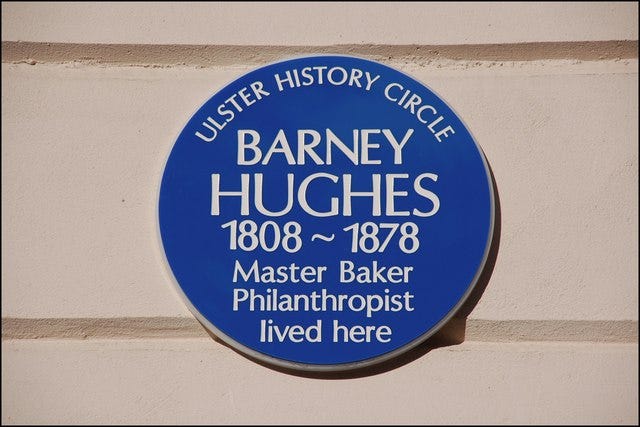
As Hughes put it before the subsequent royal commission: Catholics were regarded as “the hewers of wood and drawers of water,” though “the bone and sinew of the town” was Roman Catholic; Belfast, he maintained, was governed by Protestants “in every department.” Advancement was possible, but within unequal institutional structures largely controlled by that other.
This was reflected in the geography of a growing Belfast. Traditionally, the Catholic population was concentrated near Smithfield, Hercules Street and the Pound Loney. As the town grew, it expanded westward along the Falls Road, following the watercourses and mills of an industrial corridor. Shaped by migration, development, parish, work and kinship, the expansion was also conditioned by civil unrest. In 1857, riots at Albert Street tested that traditional boundary with Sandy Row. In 1872, unrest at Leeson Street confirmed that expansion along both sides of the Falls Road would be Catholic. This was not inevitable; the boundaries were settled over time: by builders, employers, landlords, tenants, clergy and families; by industry and the course of water; and, on occasion, by the capacity to retain one street against the other.
Geography did not dictate outcomes, but it did narrow the ground. The mills and Black Mountain constrained the district to the north; the Blackstaff and Bog Meadows to the south. By 1901, the Falls contained 41 per cent of Belfast’s Catholic population, more than all the other identifiable Catholic districts combined.
Later language of division can make these arrangements seem more settled than they ever were. By the close of the nineteenth century, however, Belfast’s industrial growth had built a predominantly Protestant city with an expanding Catholic minority, increasingly contained within one district; its economic, religious and political life shaped by inequality. That minority would have to look beyond the town, in search of resolution.
Belfast was becoming a city.