
The rapid industrial growth in Belfast was dependent upon significant inward migration. Textiles—first cotton, then linen—had driven an exceptional demographic transformation through the early nineteenth century. By mid-century, Belfast was the fastest-growing major city in the United Kingdom, drawing labour from the rural hinterland and, increasingly, from the wider island. Unlike most Irish towns during the Great Hunger, Belfast continued to grow. The distinction mattered. For a family in the midlands, or those pushed from the south and west by food insecurity and in search of work, industrial Belfast signalled employment, regular wages and a sense of permanence. There were no guarantees, but the visible signs of an economy still in motion were all there.
Despite this, Belfast did not escape hunger, fever, overcrowding or death; rather, it acquired people as other places lost them. Its industrial capacity offered an alternative to subsistence farming, and its port, mills, building sites, yards and associated trades created a demand for labour that made migration conceivable. Yet this was not an open or equal labour market. Belfast’s expanding population was overwhelmingly Protestant, while Catholics constituted a distinct and frequently disadvantaged minority. Religion shaped more than political allegiance. It affected the districts where people settled, the networks through which they might find work, and the degree of security available once secured.
For Catholics without connection, capital, or property, this would likely have meant manual labour in construction, manufacturing, transport, and warehouses. In a town being built at pace, practical skill had value. With a more secure footing, later generations could diversify into more artisan, skilled occupations. A labourer could learn a trade; a painter might find recurring work as streets, houses, workshops and mills multiplied. Employment, however, remained seasonal and subject to demand, the worker’s health, the employer’s whims, and informal religious divisions. Work gave a footing, not a guarantee. The costs of that footing were revealed in housing: rapid population growth stretched Belfast’s streets, sanitation and accommodation.
Working families were concentrated in the new districts spreading westward and southward from the old town, where houses were commonly small, densely occupied and inadequately served. The conditions were shared across confessional lines, but Catholic migrants were especially likely to inhabit neighbourhoods in which employment, kinship and religion reinforced one another. Such districts offered familiarity and mutual assistance, but they could also confine families to the poorest housing and expose them disproportionately to the diseases of overcrowded industrialisation.
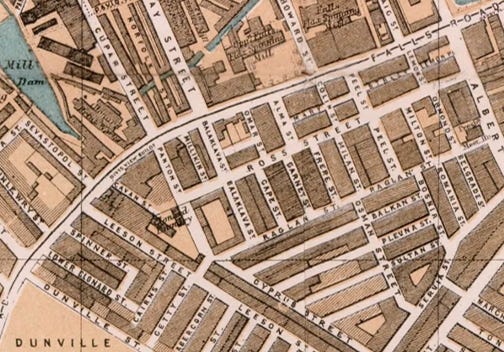
Against this backdrop of rapid growth, sectarian boundaries, and precarious labour, the Sullivan family’s own trajectory can be traced intermittently through the surviving record. By 1861, the family were living at 16 Peel Street, which ran between the Falls Road and Raglan Street.
On Christmas Day 1863, Mary died, a week before the official record might have told us how. She was 40 years old. Mary was likely buried in the churchyard at St Joseph’s, Hannahstown – almost seven years before Bishop Patrick Dorrian consecrated Milltown Cemetery. John followed in February 1867, aged 19. Phthisis, six months, uncertified—the contemporary term commonly used for pulmonary tuberculosis. A bachelor, a rougher of 19 Ross Street. Mary Clarke, 18 Derby Street, made her mark.
By 1868, Martin was living at 26 Ross Street. He left on 2 January 1870: a labourer, a widower, aged 62. Chronic bronchitis, twelve months in the making; uncertified and unattended by any doctor. His end is difficult to separate from that which had drawn him to Linenopolis two decades before: the smoke, and the work within it. The products of his labour closing in around the lungs of a man who had spent a lifetime in search of it. Eliza was there, making her mark at 20 Ross Street.
He would have been buried with Mary in Hannahstown. Eliza, a weaver, aged 24, joined them the year after: necrosis of the femur, one year, certified. The informant was a neighbour from number 25, perhaps a Henry Taggart—who didn’t need to make a mark. Meanwhile, Eliza’s surviving brothers had all served their time as painters—journeymen in Belfast’s burgeoning artisan economy.
James: Malignant disease of the liver, three months, certified – 23 August 1883. His widow, Annie, was the informant at 62 Raglan Street. He was recorded as ten years beyond his 33—a further reminder that even contemporaneous records should be read with forensic caution. James is buried in Milltown Cemetery.
Maurice married Frances (née Hesketh) in 1872. By 1901, they were living at 53 Butler Street, Belfast, with their daughters, Lizzie and Essie. On the morning of 3 May 1916, he was painting the windows of the Portrush Hotel when he placed a pair of steps on its sloping glass roof, some twelve feet above the roadway. The steps slipped. The coroner, Dr Marsh, certified a fractured base of the skull: instantaneous and accidental. He was recorded as 58 rather than 65—the sea air had done him some good, at least.
Thomas married Annie (1853–1914) in St Joseph’s, Hannahstown, on 14 June 1874. He was a twenty-eight-year-old bachelor and painter; she a twenty-year-old spinster and seamstress, the daughter of the late William Hall. The couple initially set up home at 71 Wall Street, off Carrick Hill. By 1880, the family were at 25 Roumania Street, between Raglan Street and Servia Street. Fourteen years later, home was 29 Plevna Street. By 1901, Thomas and Annie were settled at 4 Omar Street, where they would see out their days. He was fifty-three and still a house painter. Annie kept house; their daughter Mary spun linen; their son Thomas, a twenty-five-year-old widower, was a smith’s helper. A five-year-old ‘nephew’, also Thomas, completed the household. By 1911, the couple had been married for ‘40’ years. Of their eleven children, four survived. Thomas senior was still painting at seventy; Annie kept house; their daughter Mary spun linen; and their sixteen-year-old grandson, Thomas—previously noted as a nephew—had entered the family trade. Their son Thomas had not gone far. Next door, at number 6, he was a thirty-six-year-old blacksmith’s helper, married for four years to his second wife Johanna, a Glasgow-born reeler.
When Omar Street disappeared in the redevelopment of the 1960s, Thomas and Annie’s daughter Minnie and her family were still living there. Martin and Mary’s footing in Linenopolis endured.